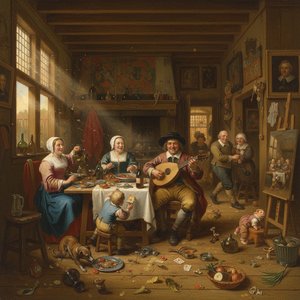
Frederick Hendrik Kaemmerer: A Master of Dutch Light
Frederick Hendrik Kaemmerer (1839 – 1904) stands as a prominent figure within the Dutch Golden Age artistic landscape, celebrated for his serene landscapes and exquisitely rendered portraits that embody the spirit of his era. Born in The Hague, Netherlands, Kaemmerer’s artistic journey unfolded against the backdrop of a nation undergoing significant social and cultural transformation—a period marked by burgeoning industrialization alongside an enduring appreciation for classical ideals and natural beauty. His work reflects this duality, capturing fleeting moments of everyday life with remarkable sensitivity and technical prowess.
- Early Life & Artistic Training: Kaemmerer’s formative years were spent honing his skills under the tutelage of Anton Mauve, a celebrated Hague School painter who championed Impressionistic techniques—a stylistic rebellion against academic conventions that would profoundly influence Kaemmerer's artistic vision.
- Impressionistic Influence: Mauve’s emphasis on capturing atmospheric conditions and utilizing loose brushstrokes proved instrumental in shaping Kaemmerer’s approach. He embraced Impressionism not merely as a stylistic trend but as a philosophical commitment to portraying the immediacy of experience, prioritizing observation over meticulous detail.
- Notable Landscapes: Kaemmerer gained considerable renown for his landscapes—particularly those depicting scenes along the Nieuwe Maas river in The Hague. These canvases are characterized by luminous color palettes and masterful depictions of light – a hallmark of the Hague School’s distinctive aesthetic. Consider “Elegant Women on the Beach,” where Kaemmerer skillfully blends pastel hues to convey the tranquil beauty of coastal life.
- Portraiture: Alongside his landscapes, Kaemmerer produced numerous portraits that showcased his exceptional ability to capture psychological nuance and physical likeness. His subjects ranged from prominent figures in Dutch society to intimate depictions of family members—each portrait imbued with a palpable sense of warmth and realism.
Major Achievements & Recognition
Kaemmerer’s artistic reputation solidified throughout his career, earning him recognition as one of the most respected landscape painters of his time. His works were exhibited extensively in Dutch salons and garnered acclaim from critics who lauded his stylistic innovation and technical mastery. Furthermore, he served as a professor at The Hague Academy of Fine Arts, nurturing the talents of aspiring artists and contributing to the continued flourishing of Dutch Impressionism.
- The Hague Academy of Fine Arts:
Kaemmerer’s role as instructor fostered a generation of painters who embraced Impressionistic principles—solidifying his legacy as a pivotal figure in shaping Dutch artistic identity.
- Salon Exhibitions:
Frequent appearances at the Royal Salon cemented his reputation and ensured that his landscapes and portraits reached a wide audience, establishing him as a household name within the art world of his era.
Historical Significance & Legacy
Frederick Hendrik Kaemmerer’s contribution to Dutch art history transcends mere stylistic innovation; he embodies the broader cultural currents of the late 19th century—a period characterized by intellectual ferment and a renewed fascination with nature. His landscapes serve as poignant reminders of a bygone era, capturing the serene beauty of Holland's waterways and countryside. Moreover, his portraits offer invaluable insights into the social dynamics and psychological complexities of Victorian Dutch society. Today, Kaemmerer’s paintings continue to inspire admiration for their understated elegance and masterful execution—a testament to his enduring artistic vision.