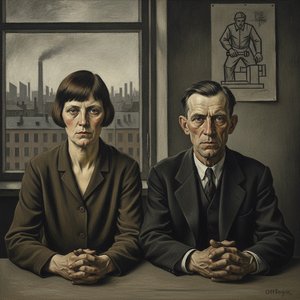
Franz Wilhelm Seiwert, born March 9, 1894, in Cologne, Germany, experienced a formative event at the tender age of seven when he suffered a severe burn during an experimental radiological treatment. This traumatic incident instilled within him a profound fear—a conviction that his life would be tragically curtailed—which irrevocably shaped his artistic trajectory and worldview. The repercussions of this accident extended beyond mere physical pain; it ignited a relentless preoccupation with mortality and fueled his determination to confront existential anxieties through his creative endeavors.
artistic career
Seiwert’s artistic journey commenced at the Cologne School of Arts and Crafts between 1910 and 1914, providing him with foundational training in traditional techniques while simultaneously exposing him to burgeoning avant-garde ideas. Recognizing the limitations of conventional aesthetics, he swiftly embraced the revolutionary currents sweeping across Europe—specifically Dadaism—and found kinship with fellow artists like Max Ernst, Hans Arp, and Johannes Baargeld. Together, they established Cologne’s influential Dada group, actively participating in its inaugural exhibition and championing its radical critique of societal norms. However, Seiwert soon charted his own course, forging a distinct path away from the collective spirit of Cologne Dada, driven by an ambition to reconcile constructivist principles with realism—a synthesis that would become central to his artistic vision.
notable exhibitions and contributions
Seiwert’s artistic reputation ascended rapidly following his debut solo exhibition at the Kunstverein in Cologne in 1923, showcasing a captivating blend of geometric abstraction and symbolic imagery. By the mid-1920s, he emerged as a pivotal figure within “The Progressive Group of Artists,” an alliance dedicated to harmonizing constructivist aesthetics with humanist values—a mission underpinned by unwavering political convictions. This group sought to redefine artistic expression as a vehicle for social transformation, mirroring the fervor of Soviet Constructivism and advocating for a utopian vision of collective progress. In 1929, Seiwert spearheaded the creation of “A-Z,” a groundbreaking journal devoted to avant-garde art that championed figurative constructivism—a stylistic approach characterized by simplified geometric forms infused with textual elements designed to convey profound ideological messages.
legacy and influence
Franz Wilhelm Seiwert’s artistic legacy transcends mere stylistic innovation; it embodies a courageous confrontation with existential dilemmas and an unwavering commitment to political activism. His distinctive blend of constructivist rigor and Marxist fervor profoundly impacted subsequent generations of artists, inspiring them to explore the intersection between formal experimentation and social critique. Notably, his work resonated deeply with Gerd Arntz, whose own artistic endeavors mirrored Seiwert’s stylistic ethos—a deliberate simplification of geometric forms intended to communicate core tenets of Marxist ideology. As a testament to his enduring influence, Seiwert's painting *Freudlose Gasse* remains an exemplar of constructivist art, embodying the group’s conviction that visual language could serve as a catalyst for societal change—a sentiment echoed in George Grosz’s *Gefährliche Strasse*, which stands in stark contrast to Seiwert’s artistic vision. His contribution to German art history is undeniable, securing his place among the vanguard of modernist thinkers and creators who dared to challenge conventional norms and envision a radically transformed future.
key dates:
- 1894: born in cologne, germany
- 1901: suffered a severe burn at the age of seven
- 1910-1914: studied at the cologne school of arts and crafts
- 1923: first large solo exhibition at the kunstverein in cologne
- 1929: founded the magazine A-Z
Por el equipo editorial de WahooArt.com
Cuestionario de arte
Cada pregunta tiene una única respuesta correcta.
Pregunta 1:
¿Cuál fue el estilo artístico principal de Franz Wilhelm Seiwert?
Pregunta 2:
¿A qué edad sufrió Seiwert un quemadura grave debido al tratamiento radiológico?
Pregunta 3:
¿Qué grupo dada lideró Seiwert junto con Max Ernst?
Pregunta 4:
¿Cuál fue el enfoque principal del periódico “A-Z” fundado por Seiwert?
Explore the profound impact of Constructivism on modern art. Discover how geometric abstraction and industrial aesthetics revolutionized design, from avant-garde textiles to architectural mastery, curated for the discerning art collector seeking depth and historical significance.
Explore the raw emotion of German Expressionism through a definitive guide to Ernst Ludwig Kirchner. Discover how his bold colors and distorted forms redefined modern art history, from Berlin street scenes to iconic masterpieces.
¡Hola! Puedo ayudarte a elegir una obra de arte, realizar el seguimiento de un pedido o resolver tus dudas sobre la garantía. ¿En qué puedo ayudarte hoy?