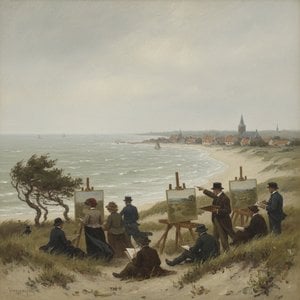
Pieter Florentius Nicolaas Jacobus Arntzenius: Unraveling the Melancholic Beauty of Dutch Cityscapes
Pieter Florentius Nicolaas Jacobus Arntzenius, affectionately known as “Floris,” stands as a compelling and often-overlooked figure within the illustrious lineage of the Hague School. Born in Surabaya, Indonesia – then a vibrant hub of the Dutch East Indies – in 1864, his artistic journey took an unexpected turn, leading him from the exotic landscapes of his youth to the misty canals and bustling streets of 19th-century Netherlands. Arntzenius’s oeuvre isn't merely a collection of paintings; it’s a poignant reflection on a nation undergoing profound transformation – industrial growth, shifting social dynamics, and an evolving appreciation for capturing the subtle poetry of the natural world.
Arntzenius’s early years were profoundly shaped by his upbringing in Indonesia. Sent to reside with relatives in Amsterdam at the tender age of eleven, he embarked on a formal artistic education, enrolling at the Rijksakademie van Beeldende Kunsten. This prestigious institution, renowned for its rigorous training and close ties to established artists, provided him with a solid foundation in classical techniques. He was mentored by influential figures such as Frederik Nachtweh, August Allebé, and Barend Wijnveld – masters who instilled within him the principles of the Hague School while simultaneously nurturing his own distinctive artistic voice.
The Echoes of the Hague School: A Unique Perspective
Undeniably influenced by the Hague School’s emphasis on atmospheric perspective and a nuanced portrayal of Dutch life, Arntzenius nevertheless forged a singular vision. Unlike some of his contemporaries who focused solely on stark realism or idealized landscapes, he excelled at capturing the atmosphere and mood of urban environments and coastal scenes with an undeniable sense of melancholy and quiet contemplation. His paintings frequently evoke a feeling of nostalgia for a bygone era, reflecting the social changes sweeping across the Netherlands.
Arntzenius’s fascination lay in depicting rain-slicked streets, fog-shrouded canals, and the interplay of light and shadow within these settings – elements that became instantly recognizable hallmarks of his work. He wasn't interested in grand narratives or heroic figures; instead, he sought to capture the quiet beauty of everyday moments, imbuing them with a subtle emotional resonance.
The Evolution of Style: From Academic Foundations to Impressionistic Sensibility
Arntzenius’s artistic development reveals a fascinating trajectory. Initially rooted in academic traditions, his style gradually embraced the looser brushwork and atmospheric effects characteristic of Impressionism. This shift is particularly evident in works like “Snow Clearing on Amsterdam Canal,” where thick impasto textures convey both the physicality of the scene and the diffused light of a winter day. The painting isn’t simply a depiction of a snowy street; it's an evocation of the resilience and quiet industry of the city’s inhabitants.
His time spent in Antwerp further broadened his artistic horizons, exposing him to diverse techniques and approaches. However, upon returning to Amsterdam, he found himself increasingly drawn to the atmospheric qualities of The Hague – a city undergoing rapid industrialization and social transformation. It was here that he truly honed his signature style: a harmonious blend of realism and Impressionism, characterized by soft colors, subtle gradations of tone, and an emphasis on capturing fleeting moments in time.
A Palette of Reflections: Themes and Subjects
Arntzenius’s artistic focus centered primarily on cityscapes and coastal scenes. He possessed a remarkable eye for detail, meticulously rendering the architecture, street life, and maritime activities of his chosen subjects. His depictions of Scheveningen, a popular seaside resort town, are particularly captivating – offering a vibrant portrayal of leisure and recreation amidst the backdrop of a rapidly evolving landscape. These paintings aren’t merely representations of places; they're imbued with a palpable atmosphere and emotional depth.
Beyond his urban and coastal subjects, Arntzenius also produced numerous genre scenes depicting everyday life in 19th-century Netherlands. These works offer intimate glimpses into the domestic routines, social interactions, and cultural practices of the time. His ability to capture the nuances of human behavior and the subtle details of ordinary moments is a testament to his artistic skill and sensitivity.
Recognition and Legacy: A Quiet Master
Despite not achieving the widespread fame enjoyed by some of his Hague School contemporaries, Pieter Arntzenius was recognized during his lifetime for his unique talent. He received prestigious awards at exhibitions in Munich, Venice, Pittsburgh, and Brussels, and his works were regularly featured in prominent art publications. His paintings found a receptive audience among collectors who appreciated his distinctive style and evocative imagery.
Today, Arntzenius’s work is valued for its atmospheric qualities, technical skill, and insightful portrayal of Dutch life in the 19th century. His paintings offer a valuable window into a bygone era, reminding us of the beauty and complexity inherent in everyday experiences. His legacy as a significant figure within the Hague School continues to grow, with scholars increasingly recognizing his contribution to the development of this influential artistic movement.