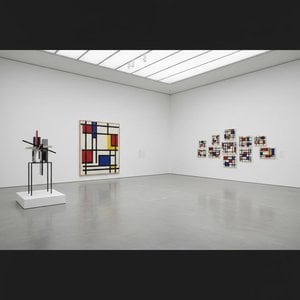
Farnese de Andrade: Pioneer of Geometric Abstraction in Brazilian Modernism
Farnese de Andrade (1926 – 1996) stands as a pivotal figure within the trajectory of Brazilian art, embodying the spirit of Grupo Frente and marking a decisive step away from traditional artistic conventions toward embracing the bold aesthetics of modernism. Born in Rio de Janeiro, Andrade’s formative years were steeped in the burgeoning cultural landscape of Brazil during its period of significant social and political transformation—a context that profoundly shaped his artistic vision. He pursued formal training at the Guignard University of Art of Minas Gerais, nurturing a generation of Brazilian artists who would champion innovative approaches to visual expression.
Andrade’s artistic journey began with an exploration of Surrealism, influenced by European avant-garde movements, yet he swiftly transitioned towards geometric abstraction, establishing himself as one of Grupo Frente's most consistent voices. This group, comprised of artists like Antônio Dias and Sérgio Espírito Santo, actively sought to redefine Brazilian art, rejecting academic formalism and embracing the principles of Cubism and Constructivism—influences that undeniably permeated Andrade’s oeuvre. His canvases became characterized by precise lines, interlocking planes, and a deliberate reduction of color palettes, prioritizing form over representation. This stylistic choice wasn't merely aesthetic; it reflected a deeper engagement with philosophical ideas concerning perception and the nature of reality – a quest to distill visual experience into its purest essence.
Grupo Frente’s ambition was nothing less than a radical reimagining of Brazilian artistic identity. Rejecting the ornate grandeur of academic painting, these artists championed simplicity and intellectual rigor, mirroring the spirit of the Bauhaus movement in Germany. Andrade's unwavering dedication to geometric abstraction became his signature style, transforming canvases into meticulously crafted compositions that explored spatial relationships with remarkable clarity. His works—such as “Sem título,” a haunting still life bathed in subtle light—and "We Came From The Sea II"—a monumental exploration of texture and color—became emblems of Grupo Frente’s pioneering spirit.
Throughout his prolific career, Andrade produced numerous paintings that continue to captivate collectors and critics alike. His artistic output spanned decades, demonstrating an enduring commitment to experimentation and a profound understanding of the visual language of modernism. Notably, “Ofélia” exemplifies Andrade's ability to convey emotion through reductive forms—a testament to the transformative power of abstraction. The Museo Nacional de Belas Artes in Rio de Janeiro proudly houses a significant collection of his masterpieces, ensuring that Farnese de Andrade’s legacy endures as a cornerstone of Brazilian artistic heritage.
Andrade’s influence extended beyond his own creations; he served as an educator at Guignard University, fostering creativity and innovation within the Brazilian art community. He instilled in countless students a passion for challenging conventions and pursuing intellectual rigor—a tradition that continues to inspire artists today. Farnese de Andrade's contribution solidified his place as one of Brazil’s foremost modernist artists, leaving an indelible mark on the history of visual culture and cementing his position as a true visionary of 20th-century Brazilian art.
Discover the profound beauty of abstract art. Our expert guide explores geometric abstraction, Op Art, and Expressionism, offering connoisseurs deep insights into collecting and curating powerful, non-representational masterpieces for sophisticated interiors.
Explore the profound essence of Neoplasticism. Discover how Piet Mondrian and De Stijl masters used pure color and geometric form to redefine modern art. An essential guide for collectors seeking to understand the enduring power of abstract harmony and universal order.
Explore the profound spiritual depth of geometric abstraction. From Malevich's Suprematism to modern masters, our expert guide reveals how pure form and color command presence in fine art collections.
¡Hola! Puedo ayudarte a elegir una obra de arte, realizar el seguimiento de un pedido o resolver tus dudas sobre la garantía. ¿En qué puedo ayudarte hoy?