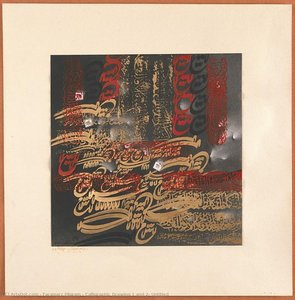
Faramarz Pilaram: Pioneer of Iranian Modernism
Faramarz Pilaram (persian: فرامرز پیلارام; 1937–1983) was an iranian painter and educator, recognized as one of the foremost figures in Iranian modern art and a pivotal contributor to the Saqqakhaneh School movement. His distinctive artistic style—characterized by abstract calligraphy—represented a bold reimagining of Persian heritage and cemented his place as a foundational voice within Iranian visual culture. Pilaram’s journey was marked by intellectual curiosity, unwavering dedication to artistic exploration, and a profound engagement with both traditional techniques and contemporary ideas.
Early Life and Education
Born April 10, 1937, in Tehran, Pilaram's formative years were deeply impacted by Jalil Ziapour’s School of Decorative Arts for Boys (Honarestān-e honarhā-ye zibā-ye pesarān)*,* where he honed his artistic skills under Mahmoud Farshchian and Shokouh Riazi. This early exposure to miniature painting instilled in him a foundational understanding of Persian artistic conventions—a knowledge that would subsequently inform his groundbreaking approach to abstraction. Pilaram pursued his academic pursuits diligently, graduating from Tehran University’s Faculty of Decorative Arts in 1965 with a master's degree specializing in painting and interior design. His studies at Elm-o-san-at University culminated in a professorship role in 1972—a position he held until 1980 where he nurtured the artistic aspirations of countless aspiring artists, shaping the future landscape of Iranian art education.
The Saqqakhaneh School and Artistic Influences
Pilaram’s contribution to Iranian art history arrived with the establishment of Iran Gallery (Tālār-e iran, later talar-e ghandriz) in 1964—a collaborative endeavor with Mansoor Ghandriz, Rouin Pakbaz, Sadeq Tabrizi, Mohammad-reza Jodat, Ghobad Shiva, Massoud Arabshahi, Sirus Malek, Farshid Mesghal
Current Meta Description: Explore Faramarz Pilaram's abstract & calligraphy-based modern paintings. Pioneer of the Saqqakhaneh school, his Iranian heritage art is a cornerstone of Iranian modernism.
Current Meta Keywords: Faramarz Pilaram, Iranian Modern Art, Saqqakhaneh School, Calligraphy Painting, Abstract Iranian Art, Pilaram Paintings, Iranian Heritage Art, Modern Persian Art, Contemporary Iran
Pilaram’s artistic vision was profoundly influenced by the legacy of Mahmoud Farshchian and Shokouh Riazi—teachers who championed a revitalized engagement with Persian artistic traditions. He drew inspiration from the elegance and fluidity of Naskh calligraphy—a script revered for its precision and expressive potential—transforming it into a central element of his distinctive style. This stylistic choice reflected a broader commitment to honoring Iran’s cultural heritage while simultaneously pushing the boundaries of artistic innovation. Alongside Farshchian and Riazi, Pilaram collaborated with Marcos Grigorian, establishing Iran Gallery as a platform for fostering dialogue between Iranian artists and international audiences—a crucial step in elevating Iran's artistic presence on the global stage.
Major Achievements and Legacy
Pilaram’s prolific output spanned decades of experimentation and exploration—resulting in numerous exhibitions across Iran and internationally. He garnered recognition for his artistic merit through prestigious awards, including the Gold Medal at the 3rd Tehran Biennial (1962), the Silver Medal at Venice Biennial (1962), First Prize from the Ministry of Art and Culture (1964), and the UNESCO World Liberation of Hunger Award (1968)—affirming his stature as a leading figure within Iranian modernism. His artworks are housed in prominent museums worldwide—including the Museum of Modern Art, Metropolitan Museum of Art, Tehran Museum of Contemporary Art, and Grey Art Gallery at NYU—demonstrating the enduring resonance of his artistic vision. Pilaram’s influence extended beyond his own oeuvre; he mentored numerous students who went on to become influential artists themselves—leaving an indelible mark on Iranian art education and shaping the trajectory of future generations. He passed away unexpectedly in 1983 at the age of 45, leaving behind a legacy of artistic innovation and unwavering devotion to preserving Iran’s cultural heritage.