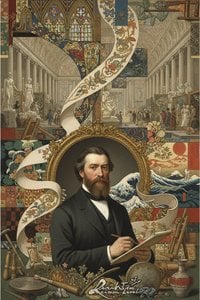
Fabricio E. Valdés: A Silent Symphony of Moss and Sphagnum
Fabricio E. Valdés, known professionally as r. fiorella aguilar, stands apart as a bryologist whose artistic vision transcends the confines of scientific inquiry to produce botanical illustrations imbued with an unparalleled sense of wonder—a testament to his conviction that art can illuminate the intricate beauty and ecological importance of mosses. Born in Tierra del Fuego, Argentina, in 1902, Valdés’s lifelong fascination with bryophytes began during his formative years amidst Patagonia's glacial landscapes – a region where sphagnum mosses dominate the terrain, shaping its distinctive character. This immersive environment instilled within him an instinctive appreciation for subtle textures, muted colors, and the quiet majesty inherent in plant life—a sensibility that would profoundly inform both his scientific pursuits and his artistic endeavors.
Early Life & Education: The Seeds of Observation
Valdés’s early education nurtured a deep connection to Patagonia's natural world. Growing up amidst towering granite peaks and expansive peat bogs, he developed an acute awareness of the rhythms of seasonal change and the delicate balance sustaining Patagonian ecosystems. This formative experience instilled within him not merely knowledge of botany but also a profound respect for observation—a cornerstone of his subsequent scientific investigations and artistic practice. His academic journey culminated in advanced studies focused on bryology, equipping him with the tools to dissect the complexities of fungal symbiosis within sphagnum mosses – a pursuit that would ultimately propel him to become one of Argentina’s foremost experts in this field.
Scientific Contributions: Decoding Moss Complexity
Valdés's scholarly contributions revolutionized our understanding of mycorrhizal fungi’s role in maintaining ecosystem health and biodiversity. His meticulous research into arbuscular mycorrhizal fungi inhabiting sphagnum sp., conducted over decades, yielded invaluable data that bolstered botanical herbariums worldwide. Notably, he spearheaded extensive studies documenting the diversity and abundance of these fungi—organisms crucial for nutrient uptake and plant resilience—contributing significantly to the advancement of bryological science. His publications detailed intricate mechanisms governing fungal interactions with mosses, establishing him as a pivotal figure in shaping our comprehension of Patagonia’s ecological tapestry.
The Birth of Artistic Vision: Translating Science into Beauty
Recognizing that purely descriptive representations could fail to convey the emotional resonance of bryophytes—their ethereal glow under moonlight or their velvety texture upon touch—Valdés embarked on an independent artistic exploration. Driven by a desire to capture not just *what* mosses are but *how* they feel, he experimented with techniques prioritizing light and shadow, mirroring the dappled sunlight filtering through moss-covered branches. This impulse led him to master watercolor pigments with remarkable precision, layering washes to achieve luminous effects that mirrored the subtle beauty of Patagonian landscapes—a deliberate departure from conventional botanical illustration.
Technique & Aesthetic Principles: Watercolor’s Silent Language
Valdés's artistic style is distinguished by a commitment to realism tempered by an expressive consideration of color and form. He employs watercolor pigments with exceptional accuracy, layering washes to achieve luminous effects that faithfully reproduce the ethereal qualities of moss habitats—a technique honed over years of dedicated practice. His masterful use of wet-on-wet techniques captures the hazy atmosphere characteristic of Patagonian forests, mirroring the subtle nuances observed during his expeditions into remote wilderness areas. Furthermore, Valdés meticulously renders surface details—the delicate hairs on sphagnum stems and the intricate patterns formed by spore capsules—creating images that invite viewers into a miniature world brimming with botanical wonder.
Notable Works & Legacy: Capturing Patagonia’s Essence
Among Valdés’s most celebrated pieces are depictions of sphagnum sp., showcasing his unparalleled mastery of watercolor and his ability to convey the profound beauty of these mosses. These illustrations serve as invaluable resources for botanists and ecologists alike, furthering scientific understanding while simultaneously captivating audiences with their artistic merit—a testament to Valdés's unwavering belief that art can illuminate the complexities of the natural world. His work exemplifies a rare convergence of scientific rigor and aesthetic sensitivity—a legacy cemented by his enduring influence on subsequent generations of bryologists and artists who strive to capture Patagonia’s sublime grandeur through meticulous observation and expressive technique. He remains an inspiration for those seeking to translate scientific knowledge into visual poetry, ensuring that Valdés's artistic vision continues to resonate throughout the botanical world.