Fa Ruozhen: Master of Misty Peaks
Fa Ruozhen (法若真, 1613–1696) stands as a singular figure in Qing dynasty art—a scholar-official who simultaneously cultivated profound poetic sensibilities and achieved remarkable artistic mastery. Born in Jiaozhou, Shandong Province, he ascended the ranks of government service but ultimately found solace and creative expression in painting, particularly in landscapes imbued with ethereal mist and towering mountains. This dedication to both intellectual pursuits and visual artistry distinguishes him from many of his contemporaries and cemented his legacy as one of Shandong’s most celebrated literati artists.
Early Life & Education: Fa Ruozhen's formative years were marked by rigorous Confucian scholarship, shaping his worldview and informing his artistic vision. He excelled in calligraphy and poetry, demonstrating a sensitivity to tonal nuance and evocative imagery—qualities that would later permeate his paintings. His upbringing instilled in him a deep appreciation for moral philosophy and the importance of cultivating inner harmony—values that profoundly influenced his artistic endeavors.
Career in Government Service: Despite facing bureaucratic obstacles during his career, Fa Ruozhen maintained positions within the Qing administration, primarily focused on forestry affairs. This role provided him with access to vast tracts of mountainous terrain, offering invaluable inspiration for his artistic explorations. He diligently served his country while simultaneously nurturing his passion for art—a testament to his balanced life and unwavering commitment to intellectual pursuits.
Fa Ruozhen’s distinctive style emerged from a confluence of influences—primarily Daoist cosmology and Buddhist contemplation—which emphasized harmony between humanity and nature. He rejected the prevailing academic conventions of his time, favoring instead a looser brushwork and expressive coloration that prioritized capturing the mood and atmosphere of the mountains rather than meticulous topographical accuracy. This approach aligns with the broader literati aesthetic, which valued spontaneity and emotional resonance above technical precision. His artistic vision was shaped by profound philosophical considerations—a reflection of the intellectual landscape of Qing dynasty China.
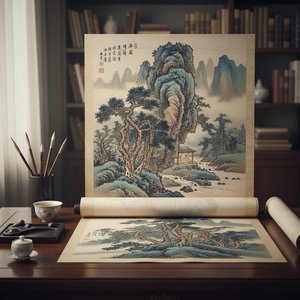
Technique & Style: Fa Ruozhen’s technique involved layering washes of ink to create luminous gradations of color—a masterful manipulation of tonal value that conveyed a sense of depth and grandeur. He skillfully employed techniques such as aerial haze and tonal recession to convey a profound sense of distance and grandeur, transporting viewers into the misty realm of Shandong’s mountains. His compositions often featured dramatic vistas, punctuated by solitary pine trees and distant peaks shrouded in mist—symbols of resilience and transcendence. This meticulous attention to detail—combined with his expressive brushwork—established him as one of Qing dynasty's foremost landscape painters.
Notable Works: Among his most celebrated paintings is “Cloudy Mountains,” completed in 1684 at the age of seventy-two. This monumental landscape exemplifies Fa Ruozhen’s mature style, showcasing a breathtaking panorama of jagged peaks bathed in soft light—a testament to his unwavering commitment to capturing the sublime beauty of the natural world. The painting "Cloudy Mountains" – housed at The Metropolitan Museum of Art – is particularly noteworthy for its masterful depiction of atmospheric perspective. Fa Ruozhen skillfully employed techniques such as aerial haze and tonal recession to convey a profound sense of distance and grandeur, transporting viewers into the misty realm of Shandong’s mountains. This artwork stands as an enduring symbol of Qing dynasty artistic achievement and continues to inspire admiration for its evocative beauty and technical brilliance.
Historical Significance: Fa Ruozhen's work represents a pivotal moment in Qing landscape painting, marking a departure from the rigid formalism of earlier generations. He championed a humanist vision of nature—one that recognized the interconnectedness between human experience and the environment—a perspective that resonated deeply with the intellectual currents of his time. His legacy extends beyond his artistic accomplishments; he embodies the ideal of the scholar-official who pursues excellence in both scholarship and art. Fa Ruozhen’s contribution to Qing art is undeniable, securing his place as a cornerstone of Shandong's cultural heritage.