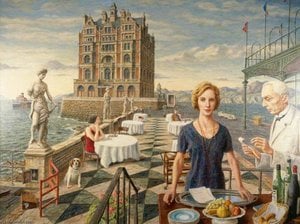
Evan Charlton: Bridging Realism and Surrealist Vision
Evan Charlton (1904 – 1984) occupies a unique position in British art history, an artist whose oeuvre resists simple categorization yet speaks powerfully to themes of domestic tranquility intertwined with unsettling dreamscapes. Born in London to Welsh parents, Charlton’s early life instilled within him a profound connection to both landscape and tradition—influences that would profoundly shape his artistic trajectory throughout his lifetime. His intellectual curiosity initially led him to pursue studies in chemistry at University College London before he decisively redirected his energies toward art at Slade School of Art between 1930 and 1933, honing his observational skills and mastering fundamental painting techniques. Charlton’s role as a teacher at the West of England College of Art in Bristol proved instrumental in nurturing artistic talent and disseminating innovative ideas within the creative community. However, the Second World War irrevocably altered the course of his life; entrusted with documenting industrial scenes alongside portraits of ordinary Britons by the War Artists Advisory Committee—a commission that demanded empathy and sensitivity—these experiences undoubtedly deepened his understanding of human experience and social responsibility. Following the war, he accepted a prestigious appointment as HM Inspector (Art) for Wales in 1945, dedicating himself tirelessly to fostering artistic education and appreciation within the region until his retirement in 1966. This period afforded him considerable autonomy to pursue his artistic passions independently, resulting in exhibitions at esteemed institutions such as the Royal West of England Academy and the New English Art Club—affirming his reputation as a respected artist recognized by fellow connoisseurs. Charlton’s distinctive artistic style achieved a remarkable balance between meticulous realism and surrealist impulses—a duality particularly evident in masterpieces like “The Artist’s Family at Llandaff” (1947). Here, he captures the warmth and intimacy of an elderly couple's home interior with expressive brushstrokes and textured impasto, conveying not merely visual accuracy but also palpable emotion. Similarly, "Station Road" (1949) presents a landscape imbued with dreamlike qualities—a testament to Charlton’s ability to translate inner visions onto canvas, reflecting the influence of artists like William Evans. His meticulous attention to detail combined with imaginative compositional choices created works that transcended mere representation, inviting viewers into contemplative dialogues about perception and memory. Charlton's artistic output extended beyond individual paintings; he actively championed Welsh art culture and collaborated closely with fellow artist Ceri Richards—a partnership marked by mutual respect and shared commitment to exploring the expressive potential of color and form. His contribution to the William Evans Bequest at Bangor University—a collection showcasing British art from the late 19th & early 20th centuries—stands as a lasting testament to his dedication to preserving artistic heritage and fostering appreciation for Welsh visual traditions. Evan Charlton’s legacy resides not only in his celebrated artworks but also in his unwavering advocacy for artistic education and cultural enrichment, securing his place as a pivotal figure within the broader panorama of twentieth-century British painting.- Early Life & Education
- Career Highlights
- Notable Works
- Influence & Legacy