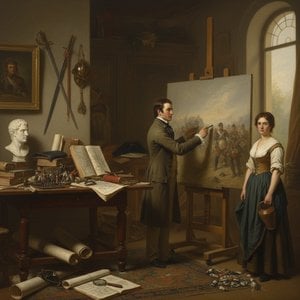
Una vida arraigada en el realismo: El mundo de Émile Friant
Émile Friant, nacido en la pequeña comuna de Dieuze en 1863, emergió como una figura fundamental que tendió un puente entre el realismo del siglo XIX y los florecientes movimientos artísticos de principios del siglo XX. Su historia de vida está profundamente entrelazada con las convulsiones políticas y sociales de su época. La guerra franco-prusiana proyectó una larga sombra sobre su infancia; la huida de su familia hacia Nancy, tras la anexión de Dieuze por parte de Prusia, le infundió un sentido de desplazamiento que, quizás, alimentó su dedicación a capturar la esencia de la vida y la identidad francesas a través de su arte. Aunque inicialmente fue orientado hacia un camino científico, el talento artístico innato de Friant se impuso rápidamente, nutrido primero por tutores privados y luego bajo la guía de Louis-Théodore Devilly en Nancy. El énfasis de Devilly en la observación directa y el detalle meticuloso sentó las bases del estilo distintivo de Friant: un realismo imbuido de profundidad emocional y perspicacia psicológica. Incluso un autorretrato de su juventud, “Le Petit Friant”, realizado con apenas quince años, captó la atención y le aseguró el permiso para realizar estudios formales en París, marcando el inicio de su ascenso en el mundo del arte.Formación parisina y primeros éxitos en el Salón
El panorama artístico parisino resultó ser tanto estimulante como desalentador para el joven Friant. Estudiar bajo la tutela de Alexandre Cabanel, un célebre pintor académico, lo expuso a técnicas establecidas, pero finalmente lo hizo sentir constreñido por el rígido sistema de los talleres. Mientras practicaba diligentemente bocetos al óleo de obras históricas, Friant anhelaba un enfoque más personal y auténtico. Este deseo lo llevó de regreso a Nancy, donde continuó perfeccionando sus habilidades mientras exhibía regularmente tanto en los salones parisinos como en los locales. Sus primeras presentaciones en el Salón, incluyendo “El hijo pródigo” e “Interior de un estudio”, demostraron un talento floreciente para la pintura narrativa y una capacidad para capturar los matificaciones de la emoción humana. Un segundo lugar en el prestigioso concurso Prix de Rome consolidó aún más su reputación, seguido de honores de tercer y luego de segundo nivel en presentaciones posteriores del Salón. De manera crucial, Friant cultivó amistades duraderas con los actores Ernest y Benoit Coquelin, lo que derivó en una serie de fascinantes encargos de retratos que se convertirían en un sello distintivo de su obra. Una beca del Salón de 1886 le permitió viajar a los Países Bajos, donde encontró las obras de los maestros holandeses, una experiencia que influyó profundamente en su uso de la luz y la sombra, así como en su atención a la vida cotidiana.Obras de madurez: Retratos, escenas de género e influencias del norte de África
La obra madura de Friant se caracteriza por retratos evocadores y escenas de género que representan las vidas de personas comunes en Nancy y más allá. Poseía una capacidad extraordinaria para capturar no solo el parecido físico, sino también el carácter interno y el estado psicológico de sus sujetos. Este talento alcanzó su apogeo con “La Toussaint” (Día de Todos los Santos), una conmovedora representación de una familia de luto junto a una tumba, que le valió una Medalla de Oro en la Exposición Universal de 1889, un testimonio de su creciente reconocimiento. Más allá del retrato, Friant encontró inspiración en el norte de África, realizando múltiples viajes a Argelia y Túnez. Estos viajes infundieron sus paisajes con una paleta vibrante y un sentido de exotismo, al tiempo que proporcionaron sujetos fascinantes para retratos que reflejaban la diversidad cultural de la región. En 1923, fue nombrado profesor de pintura en la École des Beaux-Arts de París, un cargo que reconocía su reputación establecida e influencia en el mundo del arte. Sus contribuciones fueron reconocidas además con su ascenso a Comendador de la Legión de Honor y su ingreso en el Institut de France, los honores más altos otorgados a los artistas en Francia.Un legado de realismo y precisión fotográfica
El legado artístico de Émile Friant descansa firmemente sobre su compromiso con el realismo, un estilo que abrazó mientras trascendía simultáneamente sus limitaciones. Aunque inicialmente fue moldeado por el énfasis de Devilly en la observación directa y las técnicas académicas de Cabanel, Friant desarrolló una voz distintiva que fue más allá de la adherencia estricta a cualquiera de ambos enfoques. No le interesaba simplemente replicar la realidad; más bien, buscaba dotar a sus pinturas de resonancia emocional y profundidad psicológica. Su uso innovador de la fotografía como herramienta preparatoria —una práctica cada vez más común entre los artistas de la época— demuestra un compromiso con las tecnologías emergentes y un deseo de exactitud en la representación. Él representa un vínculo crucial entre el naturalismo del siglo XIX y las innovaciones artísticas de principios del siglo XX, contribuyendo a la evolución de la pintura francesa mientras permanecía fiel a sus principios fundamentales. Algunos lo consideran uno de los últimos grandes naturalistas, preservando una tradición de observación meticulosa y honestidad emocional en una era de cambios rápidos. Su trágica muerte en 1932 —al caer desde una altura en París— puso un fin abrupto a una carrera notable, pero sus pinturas continúan cautivando al público con su belleza, sensibilidad y relevancia perdurable. La obra de Friant sirve como un poderoso recordatorio de la importancia de capturar la experiencia humana con precisión y compasión.Preguntas y respuestas
¿De dónde es Émile Friant?
Émile Friant nació en Francia.
¿Dónde se encuentran las obras de Émile Friant agrupadas por paleta?
La página Por paletas de colores agrupa las obras de Émile Friant según sus paletas de colores.
¿Dónde puedo ver el perfil cromático de la obra de Émile Friant?
El perfil cromático de la obra de Émile Friant se muestra en la página Genoma de la Paleta del artista.