The Quiet Master of Watercolor: The Life and Legacy of Eliot O'Hara
In the delicate, translucent world of watercolor, few names command as much respect for technical precision and atmospheric soul as Eliot O'Hara. Born in 1890 in Waltham, Massachusetts, O’Hara did not follow the traditional path of a sheltered academic artist. Instead, his journey was one of profound responsibility and self-directed discovery. Following the untimely death of his father, Daniel O’Hara, in 1912, the young artist stepped into the mantle of the family manufacturing business. For years, he balanced the pragmatic demands of the O'Hara Waltham Dial Company with a growing, quiet passion for the brush. It was not through formal, early training, but through a relentless, solitary dedication to mastering the medium that he transformed himself from a businessman into one of the twentieth century’s most influential watercolorists.
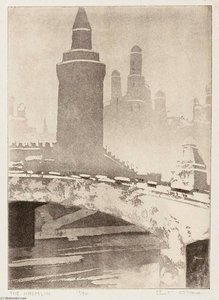
The true awakening of O'Hara’s artistic spirit arrived through travel and exploration. His 1924 journey through Europe served as a vital catalyst, exposing him to new light, color, and cultural textures that would forever haunt his canvases. This thirst for the world led him to embark on an epic odyssey through Soviet Russia in 1929, supported by a prestigious Guggenheim Fellowship. Traveling by train, horseback, and foot, he captured the rugged grandeur of the Russian landscape, producing over a hundred sketches and watercolors that would later be completed in the studios of Paris. These works, ranging from dramatic woodcuts like The Kremlin to sweeping landscapes, showcased an artist capable of translating the monumental power of foreign lands into the intimate language of watercolor.
A Legacy of Instruction and Artistic Spirit
Beyond his personal canvases, O'Hara’s impact was felt most deeply through his role as a mentor and educator. In 1931, he established the Eliot O'Hara School for Watercolor Painting in Goose Rocks Beach, Maine—the first institution of its kind in the United States. He believed that technique was not an end in itself, but a vital vehicle for expression. His teaching philosophy emphasized the mastery of light and the ability to capture the fleeting "impressionistic" moment. Though the school was tragically lost in the Great Fires of 1947, O'Hara’s spirit remained unextinguished. He continued to share his wisdom through summer workshops across the country and through a series of influential instructional books, the first of which appeared in 1931 and the last in 1966.
His life was marked by a remarkable versatility and a sense of duty that extended even to his service during World War II, where he worked within the Camouflage Section of the U.S. Navy. This same eye for detail and environmental nuance informed his plein air paintings, which spanned the globe from the coasts of Alaska to the vibrant landscapes of Japan, China, Indonesia, and Thailand. Today, his work remains a cornerstone of American watercolor tradition:
- Technical Mastery: Renowned for his ability to manipulate the transparency and luminosity of the medium to create depth and atmosphere.
- Global Vision: A prolific chronicler of international landscapes, bringing the light of distant lands to American audiences.
- Educational Impact: An influential author and filmmaker whose instructional methods shaped generations of watercolorists.
- Institutional Recognition: His works are preserved in prestigious collections, including over 120 pieces held by the Ogunquit Museum of American Art.
Eliot O'Hara passed away in 1969, leaving behind a body of work that serves as a testament to the power of disciplined observation. He remains a "quiet master," an artist who found his greatest voice not in the clamor of fame, but in the subtle, flowing dance of pigment and water.