Early Life and Artistic Foundations
Eduardo José de Sousa Malta, a pivotal figure in Portuguese art of the 20th century, was born in Lisbon, Portugal, in 1899. His early years were steeped in the vibrant cultural atmosphere of the capital city, an environment that would profoundly shape his artistic sensibilities. He received his initial artistic training at the prestigious Lisbon School of Fine Arts, a renowned institution where he diligently honed his skills in painting and illustration – disciplines that laid the groundwork for his distinctive style. This formative period instilled within him not only technical proficiency but also a deep appreciation for Portuguese traditions and aesthetics, elements which would later become central to his oeuvre.Artistic Style and Notable Works
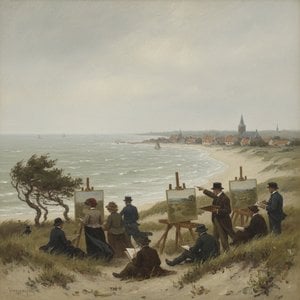
Malta’s artistic journey is characterized by remarkable versatility, encompassing portraits, landscapes, and still lifes with equal mastery. His paintings are distinguished by their meticulous realism, a hallmark of his approach that sought to capture the essence of his subjects – be they human figures or natural scenes – with an almost photographic precision. A prime example of this skill is “Portrait of Luísa Maria” (held at the Museu do Caramulo), where he masterfully conveys both the sitter’s likeness and her inner character, revealing a sensitivity to nuance that elevates the portrait beyond mere representation. Equally compelling is "Untitled" (located in the Centro de Arte Moderna Gulbenkian), which demonstrates his ability to translate complex emotions and atmospheres onto canvas through subtle color palettes and carefully constructed compositions. These works, alongside others, showcase Malta’s dedication to portraying the soul of Portugal through a realistic lens.Career and Artistic Community
Malta's artistic career was marked by active participation in prominent Portuguese art circles. He became a member of both the Portuguese Society of Fine Arts and the National Society of Fine Arts in France – affiliations that provided him with invaluable opportunities for exposure, collaboration, and professional development. His work garnered recognition through exhibitions held at institutions such as Worcester College in Oxford, UK, further solidifying his reputation within the international art community. These engagements underscored his commitment to sharing his artistic vision with a wider audience and engaging with fellow artists.Legacy and Historical Context
Eduardo José de Sousa Malta’s legacy extends beyond his individual works; he represents a significant chapter in Portuguese art history. His paintings offer a valuable window into the cultural landscape of his time, reflecting both the traditions of Portugal and the evolving artistic trends of the 20th century. His dedication to portraying the “Portuguese soul,” as he himself described it, through competent technical execution and an understanding of national customs and traditions, cemented his place as a key figure in capturing the spirit of his nation on canvas. Today, his works can be appreciated through platforms like WahooArt.com, ensuring that his artistic contributions continue to inspire and resonate with art enthusiasts worldwide. His influence is also visible within museums such as the Museu do Caramulo and the Centro de Arte Moderna Gulbenkian, where his paintings are treasured for their beauty and historical significance.Preguntas y respuestas
¿Puedo visitar un museo virtual con las obras de Eduardo Malta?
La Galería 3D de Eduardo Malta es una página que muestra las obras del artista en una galería virtual tridimensional.
¿Dónde puedo ver las obras de Eduardo Malta en orden cronológico?
La página de Cronología de obras del artista presenta las obras de Eduardo Malta ordenadas cronológicamente, año tras año.
¿Puedo explorar las obras de Eduardo Malta por estado de ánimo?
Puedes explorar las obras de Eduardo Malta por estado de ánimo en su página Rincón de emociones, donde las piezas se organizan según la emoción que transmiten.