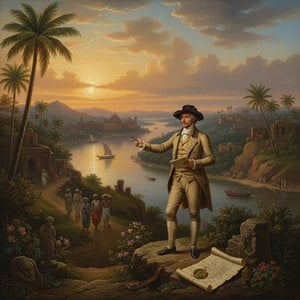
Dr. William Henry Pigou: Pioneer of Colonial Indian Photography
William Henry Pigou, born in Amiens, France, in 1818, was a multifaceted figure whose legacy extends beyond his medical practice to encompass a remarkable contribution to the visual arts—specifically, photography during the Victorian era’s colonial expansion into India. His family history traced back to Huguenot origins, reflecting the intellectual and artistic vibrancy of early modern Europe. The Pigou surname itself carries roots in “pike,” symbolizing strength and nobility, mirroring the resolute spirit evident in his life's work.
Early Life and Education
Pigou’s formative years were marked by a rigorous academic pursuit—he earned a doctorate from Edinburgh University, demonstrating an aptitude for scientific inquiry that would later inform his photographic endeavors. This intellectual grounding instilled within him a meticulous attention to detail and a desire to accurately represent the world around him, qualities crucial for mastering the nascent art of capturing images.
Service in India and Photographic Innovation
Pigou’s professional trajectory took him to Bombay (Mumbai), where he joined the Indian Medical Service in 1841. This role provided invaluable experience observing the social fabric and healthcare challenges of British colonial rule, shaping his worldview and influencing his artistic vision. Notably, he succeeded Thomas Biggs as official government photographer, Bombay Presidency in 1856-1857—a position that allowed him to directly engage with documenting India’s architectural heritage. He embarked on a mission to record monumental structures like the Brahma Jinalaya at Lakkundi and the Mallikarjuna Temple at Kuruvathi, employing innovative techniques for his time to produce stunning images that captured the grandeur of ancient Indian civilization.
Technique and Artistic Style
Pigou’s photographic style distinguished itself through its commitment to realism and careful composition. He utilized wet collodion photography—a complex process requiring immediate exposure and processing—to achieve exceptional clarity and tonal range, capturing textures and nuances often missed by earlier methods. His images are characterized by a humanist sensibility, portraying subjects with dignity and respect, reflecting his belief in the importance of documenting cultural traditions and preserving historical monuments.
Influence and Legacy
Pigou’s work resonated deeply within the broader artistic landscape of the era, influencing subsequent photographers and contributing to the development of visual culture in India. His meticulous documentation served as a cornerstone for understanding colonial India's architectural achievements and fostered appreciation for its rich heritage. Furthermore, Pigou’s dedication to scientific observation—embodied in his medical practice—mirrored a broader intellectual movement prioritizing empirical research alongside artistic expression. He is remembered not only as a skilled photographer but also as a symbol of the humanist spirit that underpinned Victorian scholarship and artistic innovation. His legacy continues to inspire artists today, reminding us of the transformative power of combining scientific curiosity with aesthetic sensitivity.
Notable Museums Exhibiting Pigou’s Artwork
Pigou's photographic masterpieces can be admired at prestigious institutions such as the Musée Carnavalet in Paris, which delves into the history of Parisian life and its inhabitants—a testament to his enduring influence on artistic representation and cultural understanding. Explore more about William Henry Pigou’s work and its impact on art history at
WahooArt.com.