Early Life and Education
Đoko Mazalić, a pivotal figure in Bosnian art history, was born on April 23rd, 1888, in Bosanska Kostajnica, a town steeped in tradition and natural beauty – a landscape that would profoundly influence his artistic vision. He emerged as one of the first generation of Bosnian painters to receive formal training at the prestigious Academy of Fine Arts in Budapest between 1910 and 1914. This period marked a crucial turning point, exposing him to European artistic currents while simultaneously grounding him in the rich cultural heritage of his homeland. Alongside fellow artists like Gabrijel Jurkić, Petar Tiješić, and Špiro Bočarić, Mazalić honed his skills, absorbing techniques and philosophies that would later shape his distinctive style. His early studies laid the foundation for a career dedicated to capturing the essence of Bosnia and Herzegovina through his art.Artistic Career and Style
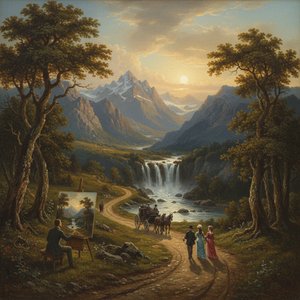
Mazalić’s artistic journey is characterized by remarkable stylistic versatility and an unwavering commitment to quality. While he embraced various influences throughout his career, his paintings, particularly landscapes, stand as some of his most compelling achievements. He possessed a unique ability to distill the soul of nature onto canvas, imbuing each scene with a sense of atmosphere and emotion. The “Motif from Vranduk” (1920), for instance, exemplifies this talent – it’s not merely a depiction of a landscape but an evocation of its spirit, capturing the light, texture, and mood of the Bosnian countryside. His work demonstrates a fascinating interplay between realism and impressionism, often incorporating elements of symbolism and a subtle expressionistic sensibility. He navigated a diverse range of styles, from the classicism of his early years to hints of abstraction that occasionally peek through in his later works, always maintaining a remarkable consistency in his artistic vision.Teaching and Legacy
From 1923 until 1945, Đoko Mazalić dedicated himself to nurturing the next generation of Bosnian artists as a teacher in Sarajevo and Travnik. This role wasn’t merely pedagogical; it was an integral part of his artistic practice. He left an indelible mark on the art scene, shaping the sensibilities of countless young painters who followed in his footsteps. Beyond his classroom duties, Mazalić actively participated in the cultural life of Sarajevo, contributing to the formation of groups like “Četvorica” (The Four) and “Krug” (The Circle), fostering a vibrant artistic community. He also undertook significant conservation work on paintings and icons, demonstrating a deep understanding of art history and technique. Notably, he played a key role in establishing the Art Gallery of the National Museum of Bosnia and Herzegovina in 1930, serving as its director on a voluntary basis until 1943. His intellectual pursuits culminated in the publication of “Lexicon of Artists of B&H” (1965) and “The Art of Painting in B&H in the Turkish Era” (1967), scholarly works that cemented his position as a leading authority on Bosnian art history. Towards the end of his career, he contributed to the Institute for the Protection of Cultural Monuments in Sarajevo, further solidifying his commitment to preserving Bosnia’s artistic heritage.Notable Works and Historical Significance
Mazalić's oeuvre is rich and diverse, reflecting a lifelong exploration of themes ranging from folklore motifs and civic portraits to religious subjects and evocative landscapes. His “Motif from Vogošća” (1930) offers a glimpse into the urban life of Sarajevo, while "Village under snow" (1930) captures the serene beauty of winter in Bosnia. His dedication to capturing the essence of his homeland is evident throughout his work. He was one of the few Bosnian painters who chose to return home after studying abroad, establishing himself as a central figure in the post-war Sarajevo art scene. His artistic legacy extends beyond individual paintings; it represents a vital connection between tradition and modernity, a testament to the enduring power of art to capture the spirit of a nation. Mazalić’s work continues to inspire artists and art enthusiasts alike, securing his place as a cornerstone of Bosnian art history.Preguntas y respuestas
¿Dónde puedo ver las obras de Đoko Mazalić organizadas por atmósfera?
La página de Galería de estados de ánimo del artista muestra las obras de Đoko Mazalić organizadas según su atmósfera.
¿Cuál es el lugar y el año de nacimiento de Đoko Mazalić?
Đoko Mazalić nació en Bosanska Kostajnica en 1888.
¿En qué ciudad y país nació Đoko Mazalić?
Đoko Mazalić nació en Bosanska Kostajnica, en Bosnia y Herzegovina.
¿Cómo puedo encontrar obras de Đoko Mazalić en una paleta específica?
Las obras de Đoko Mazalić pueden explorarse por paleta de colores en la página de Por paletas de colores del artista.
¿Dónde se encuentran las obras de Đoko Mazalić organizadas por color?
La página Índice Espectral organiza las obras de Đoko Mazalić por color.
¿Dónde se encuentran las obras de Đoko Mazalić agrupadas por técnica?
Las obras de Đoko Mazalić pueden explorarse por técnica en la página de Todos los medios del artista.
¿De dónde es Đoko Mazalić?
Đoko Mazalić nació en Bosnia y Herzegovina.