Daniele Buetti: Piercing the Veil of Beauty
Daniele Buetti (born 1955) stands as a singular voice within contemporary art, recognized for his unsettling yet profoundly thoughtful explorations into themes of identity, perception, and the pervasive influence of consumer culture. Rooted in Fribourg, Switzerland, Buetti’s artistic journey began with a fascination for photography and sculpture, evolving into a multifaceted practice encompassing installation, intervention, sound, video, and digital media—a testament to his relentless pursuit of innovative expression.
Early Influences: Buetti's formative years were profoundly shaped by the intellectual currents emanating from thinkers like Jean Baudrillard and Giorgio Agamben. These philosophers interrogated fundamental concepts – simulacra and hyperreality – challenging conventional understandings of representation and questioning whether images truly reflect reality. This conceptual bedrock would become inextricably interwoven with his artistic vision, informing his critique of cultural narratives and prompting him to confront viewers with uncomfortable truths.
The Critique of Beauty: Buetti’s breakthrough arrived in the 1990s through a series of daring interventions targeting glossy advertisements featuring fashion models and luxury products circulated by prominent magazines. Armed with a ballpoint pen, he undertook meticulous punctures onto these surfaces—a deliberate act designed to disrupt idealized portrayals and expose the hollowness beneath the veneer of consumer desire. This provocative gesture served as a cornerstone of his artistic methodology, demonstrating his commitment to disrupting established aesthetic standards and sparking critical reflection on societal values.
A Methodical Approach to Disruption
Buetti’s artistic process prioritizes careful planning and meticulous execution. He approaches each project with an acute awareness of materiality and context, transforming ordinary spaces into immersive environments that encourage contemplation. His interventions transcend mere destruction; they are precisely calibrated gestures intended to provoke dialogue about how we perceive visual information—a characteristic that distinguishes him from many other artists of his time.
Photography as Catalyst: Buetti’s photographic work consistently investigates the complex relationship between image and reality, frequently utilizing collage and montage techniques to construct layered narratives that defy simplistic interpretations. These images are not merely representations but rather explorations of memory, emotion, and subjective experience—reflecting a deep engagement with the philosophical questions posed by Baudrillard and Agamben.
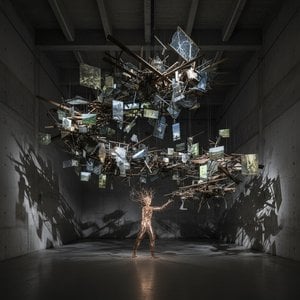
Installation Art: Buetti’s installations – notably “Auf allen knien” at Kunsthaus Bregenz – represent a significant contribution to contemporary sculptural practice. These spaces are conceived as arenas for confronting uncomfortable truths, utilizing sculptural elements combined with soundscapes to heighten emotional impact and stimulate intellectual engagement. His work embodies a desire to challenge viewers' preconceptions and provoke contemplation on the role of art in shaping our understanding of the world around us.
Notable Exhibitions & Collections
Buetti’s artistic achievements have garnered international recognition, appearing in prestigious museums including Schirn Kunsthalle Frankfurt, Kunsthaus Wien, Reina Sofía Museum in Madrid, Museo Nacional Centro de Arte Reina Sofía and ZKM Karlsruhe. His pieces reside within prominent collections like the DaimlerChrysler Collection in Berlin and Fotomuseum Winterthur—a testament to his enduring influence on the art world and a celebration of his unwavering dedication to artistic experimentation.
Legacy & Significance
Daniele Buetti’s legacy resides in his uncompromising stance against complacency and his insistence on confronting audiences with unsettling realities. He compels us to reconsider our assumptions about beauty, representation, and the transformative potential of art—a conviction that continues to resonate throughout his oeuvre and solidify his position as a pivotal figure in shaping the trajectory of contemporary artistic discourse.