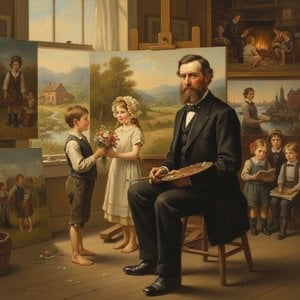
Christopher High Shearer: Painter of Appalachian Majesty
Christopher High Shearer (1846 – 1926) stands as a pivotal figure in American landscape painting, particularly renowned for his monumental depictions of the Smoky Mountains and Allegheny Highlands. Born in Reading, Pennsylvania, Shearer’s artistic journey began amidst the formative influences of Francis Daniel Devlan and John Heyl Raser, two prominent artists who instilled in him a foundational understanding of tonalist aesthetics – a style characterized by subdued colors and atmospheric perspective that prioritized capturing the mood and essence of nature over precise topographical accuracy.
Early Influences & Artistic Formation
His father’s encouragement fueled his ambition to pursue painting professionally, establishing a studio in their backyard farm—a deliberate decision reflecting the importance of rural landscapes within Shearer's artistic worldview. Recognizing his talent early on, he enrolled at Devlan and Raser’s studios, absorbing techniques that would shape his distinctive style. This immersive education solidified his commitment to capturing the sublime beauty of the American wilderness with unwavering dedication. He was fascinated by butterflies as a child, spending time outdoors observing their delicate movements and vibrant hues—a formative experience that instilled in him an appreciation for detail and observation—skills he would later translate into his paintings.
European Studies & Stylistic Evolution
At eighteen, Shearer embarked upon a transformative European expedition, studying in Düsseldorf and Munich—experiences profoundly impacting his artistic sensibilities. The Düsseldorf Akademie der Bildenden Künste awarded him a gold medal upon his return, acknowledging his burgeoning reputation as an artist. Furthermore, Shearer’s exhibitions at the Pennsylvania Academy of Fine Arts and the Centennial Exposition celebrated America's bicentennial year, securing his place within the artistic discourse of his time. These travels exposed him to Impressionist ideas, subtly blending into his mature compositions. He sought inspiration from artists like Claude Monet and Camille Pissarro, experimenting with looser brushstrokes and brighter palettes—a deliberate departure from the stricter conventions of tonalism that would characterize his early work.
Notable Works & Artistic Legacy
Shearer’s magnum opus, “Smoky Range,” exemplifies the tonalist tradition—a breathtaking panorama showcasing the grandeur and solemn beauty of the Appalachian Mountains. Its masterful use of muted hues and atmospheric haze conveys a palpable sense of tranquility and reverence for the natural world. Beyond this iconic painting, Shearer's oeuvre includes numerous landscapes residing in collections across Canada, Australia, Germany, and the United States, cementing his enduring contribution to American art history. His work continues to inspire admiration for its emotive power and technical brilliance. The painting’s composition—characterized by horizontal bands of color and a central pathway leading into the distance—mirrors the Romantic tradition's fascination with sublime vistas and spiritual contemplation.
Teaching & Institutional Involvement
Driven by a passion for fostering artistic development within his community, Shearer established an art studio in Reading, Pennsylvania, offering instruction to aspiring artists—particularly those residing in Berks County. He played a crucial role in the founding of the Reading Public Museum, serving as its chief curator until his passing—a testament to his unwavering devotion to preserving and promoting artistic heritage. His dedication to educating future generations of artists ensured that Shearer’s influence would extend far beyond his own lifetime.