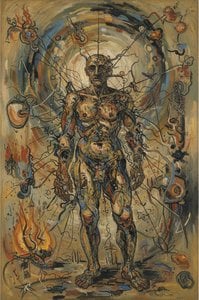
Charles Henri Ford
Charles Henri Ford (1908–2002) was an American poet, novelist, diarist, filmmaker, photographer, and collage artist whose multifaceted artistic career spanned the entirety of the 20th century. He stands as a pivotal figure in the Surrealist movement’s expansion into New York City and represents a significant contribution to experimental literature and visual art.Early Life and Artistic Beginnings
Born in Brookhaven, Mississippi, Ford's upbringing within a Baptist family contrasted sharply with his intellectual inclinations. Despite familial traditions, he pursued education at Catholic boarding schools, fostering an appreciation for diverse cultural perspectives that would later permeate his artistic endeavors. His initial foray into creative expression began with poetry—a passion solidified by formative influences from William Carlos Williams and Gertrude Stein—establishing him as one of the foremost voices of American Surrealism.Literary Achievements: Novels and Poetry
Ford’s literary output was prolific, encompassing more than a dozen collections of poems and collaborative novels such as *The Young and Evil* alongside Parker Tyler. This novel bravely confronted themes of genderqueerness within the artistic community of Greenwich Village during the Great Depression, marking an early exploration of LGBTQ+ identity in literature. His poetic works—including *The Garden of Disorder*, published in 1938—were characterized by dreamlike imagery and a willingness to engage with political concerns, as evidenced by his poignant poem “Now I Climb Death’s Tree,” which powerfully addressed the confrontation between Black individuals and lynch mobs during the Jim Crow era.Film Direction and Surrealist Collaboration
Beyond poetry, Ford ventured into filmmaking, directing experimental films that showcased his innovative vision. Notably, he partnered with Pavel Tchelitchew, forging a lasting artistic relationship marked by mutual admiration and collaborative projects. Together they established View Editions, publishing groundbreaking works on Marcel Duchamp and translating André Breton’s poems into English—a testament to Ford's commitment to fostering dialogue within the Surrealist movement.Associations with Notable Artists
Ford cultivated connections with luminaries of his time, including Gertrude Stein, Natalie Barney, Man Ray, and Jorge Luis Borges. These collaborations enriched his artistic practice and broadened his engagement with diverse cultural currents. His involvement in Andy Warhol’s circle introduced him to Pop Art aesthetics, furthering his exploration of visual language and challenging conventional artistic boundaries.Legacy and Impact
Charles Henri Ford's legacy resides in his pioneering role as America’s first Surrealist poet—a position he earned through unwavering dedication to experimental art forms and a courageous willingness to confront societal prejudices. His work continues to inspire artists and scholars alike, cementing his place as an enduring figure within the history of 20th-century literature and visual culture. He passed away in 2002 at the age of 94, residing peacefully in New York City’s Dakota apartment building—a landmark residence that housed a celebrated collection of artworks.- Museums: WahooArt's virtual museum: https://WahooArt.com/art.nsf/o/a@d3c5zh
- Further Reading: Charles Henri Ford, interview by Allen Frame,Journal of Contemporary Artwebsite, www.jca-online.com
- Additional Resources: Charles Henri Ford Papers, 1928–1981, Harry Ransom Humanities Research Center, University of Texas at Austin;
- Online Presence: New York Times (30 September 2002)