early life and formative years
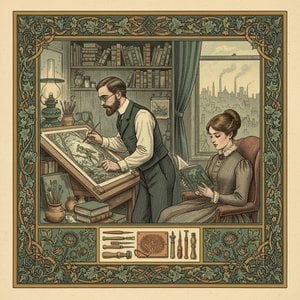
Charles Frederick Tunnicliffe (1901–1979) was born in Langley, a small village near Macclesfield in Cheshire. His father William was a shoemaker but was advised by his doctor for the good of his health to give up the workshop and pursue a life outdoors. When he and his wife Margaret learned that Lane Ends Farm in nearby Sutton Lane Ends was available for sale, they quickly made the decision to move and make a fresh start. The farm had around 20 acres of land, enough for them to raise cattle and keep horses, pigs and poultry. From an early age, Tunnicliffe displayed a gift for drawing, undoubtedly inspired by his immediate surroundings. Armed with white chalk, he drew farm animals on the black creosoted walls of the farm's outbuildings, initially to his father’s disapproval. Soon, as his ability developed, his parents bought him paper, sketchbooks and art materials. At school, his talent was spotted by his headmaster, Buckley Moffat, who further encouraged his development as an artist and helped him secure a scholarship to attend the Macclesfield School of Art and Design. There, under the guidance of Principal Thomas Cartwright, Tunnicliffe's formal training as an artist began. He excelled at his work, showing an all-round ability in a variety of media. Cartwright rightly believed that he had much potential, and encouraged his student to try for a place at London’s Royal College of Art.artistic career
At 19 years of age, he easily passed the entrance exams and the college confirmed that his work was worthy of a scholarship. However, he knew that he would dislike London, being a complete opposite to the area where he grew up and away from his beloved countryside and animals, but the prospect of being taught at one of the world's most prestigious art schools, where many of the great masters had trained, eased his apprehensions. In London, his work surpassed all expectations. He eventually passed with a diploma and accepted the offer to stay another year to train as an etcher. To achieve accuracy in his illustrations for *Peregrine Saga*, Tunnicliffe travelled to Avebury in Wiltshire to meet a group of falconers. The club secretary gave permission for him to draw and study the birds at close quarters. In addition to peregrines, Tunnicliffe was able to study goshawks, sparrowhawks and merlins. He spent five days in their company.notable works and achievements
Tunnicliffe's work is characterized by its precision and accuracy, showcasing birds in their natural settings. Some of his notable works include:- Tarka the Otter, a novel illustrated for henry williamson in 1927, which brought him international acclaim.
- brooke bond tea cards, seen by millions of young people in the uk during the 1950s and 1960s.
- ladybird books, featuring his naturalistic illustrations.
- cover illustrations for the Royal Society for the Protection of Birds’ (rspb) magazine *Bird Notes*, starting from march 1953.
legacy and honors
Tunnicliffe's body of work is now housed at Oriel Ynys Môn, near Llangefni. He was honored with:- 1944: associate of the Royal Academy
- 1954: fellow of the Royal Academy
- 1975: rspb gold medal
- 1978: obe (order of the british empire)
Preguntas y respuestas
¿En qué ciudad y país nació Charles Frederick Tunnicliffe?
Charles Frederick Tunnicliffe nació en Langley, Reino Unido.
¿Puedo explorar las obras de Charles Frederick Tunnicliffe por tema?
Las obras de Charles Frederick Tunnicliffe pueden explorarse por tema en la página Índice temático del artista.
¿Cómo evolucionó el arte de Charles Frederick Tunnicliffe a lo largo del tiempo?
La Trayectoria de Charles Frederick Tunnicliffe es una línea de tiempo con desplazamiento vertical que presenta las obras del artista en orden cronológico, agrupadas en capítulos por periodos de su carrera.