Caspar Barlaeus (February 12, 1584 – January 14, 1648): A Renaissance Polymath Bridging Art and History
Caspar Barlaeus (February 12, 1584 – January 14, 1648) stands as a remarkable figure of the Dutch Renaissance, embodying an extraordinary blend of artistic talent and scholarly pursuits. Born in Antwerp, Belgium, he navigated the turbulent waters of his era—marked by religious upheaval and burgeoning exploration—leaving behind a legacy that continues to fascinate historians and art connoisseurs alike. His multifaceted intellect extended beyond painting into theology, poetry, and meticulous historical research, cementing his place as one of the most erudite minds of his time.
Early Life and Artistic Training
Barlaeus’s formative years were steeped in humanist ideals prevalent throughout Europe during the sixteenth century. Antwerp, a vibrant hub for Flemish art and commerce, provided him with an ideal environment for artistic development. Biographical details remain somewhat sparse, but evidence suggests he received instruction from prominent artists of his day, absorbing techniques and stylistic sensibilities that would inform his later works. This exposure to the glories of Renaissance painting undoubtedly instilled in him a deep appreciation for beauty and craftsmanship—qualities that would permeate his artistic endeavors. Although precise documentation concerning Barlaeus’s formal training is limited, it's widely accepted that he benefited from the influence of masters such as Pieter Bruegel the Elder and Jan van Eyck, absorbing their mastery of perspective and color palettes – elements which would subsequently find expression in his own paintings.
Notable Paintings: Friburgum and Olinda
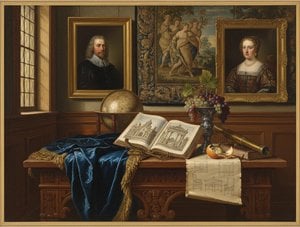
Barlaeus’s artistic output is relatively modest compared to many contemporaries, yet two canvases – *Friburgum* and *Olinda* – offer compelling glimpses into his aesthetic sensibilities. These masterpieces showcase a masterful command of color and composition, reflecting the influence of Mannerism, a stylistic movement characterized by elongated figures and dramatic contrasts. The meticulous detail evident in both pieces speaks to Barlaeus’s dedication to realism—a hallmark of Renaissance art—albeit tempered with expressive distortions that convey emotional depth. You can admire *Friburgum* at
here and *Olinda* at
here. The canvases depict scenes from biblical narratives, demonstrating Barlaeus’s understanding of religious iconography and his ability to translate theological concepts into visual form.
Historical Writings: Rerum per Octennivm in Brasilia
Beyond his artistic pursuits, Barlaeus distinguished himself as a prolific historian. His magnum opus, *Rerum per Octennivm in Brasilia* (Concerning the Eighteen Years), meticulously documented Dutch colonization efforts in Brazil during the seventeenth century. This ambitious undertaking demanded considerable erudition—spanning geography, botany, ethnography, and diplomacy—and resulted in a groundbreaking work that challenged conventional narratives surrounding European expansionism. Barlaeus’s meticulous research combined with his eloquent prose established him as a pioneer of historical scholarship, shaping perceptions of Brazilian history for generations to come. The atlas *Brasil* produced by Barlaeus is considered one of the most important cartographic achievements of its time, incorporating innovative techniques and presenting detailed depictions of the New World landscape. You can view *Rerum per Octennivm in Brasilia* at
here.
Legacy and Significance
Caspar Barlaeus’s contribution to both art and scholarship transcends mere stylistic innovation or factual accuracy. He embodies the humanist spirit of his time—a commitment to reason, observation, and a profound understanding of human experience. His paintings serve as tangible reminders of the artistic achievements of the Dutch Renaissance, while his historical writings illuminate crucial episodes in European colonial history. Barlaeus’s legacy continues to inspire scholars and artists alike, demonstrating that intellectual curiosity and creative expression can coexist harmoniously—resulting in works that enrich our knowledge of both art and human civilization. His artistic style is showcased at
here.