early life and career
Charles Philips, born around 1703 in London, was immersed in the artistic atmosphere of his time from a young age. As the son of Richard Philips, also a portraitist—a profession that would shape his own path—he absorbed the techniques and sensibilities prevalent within the British art scene.
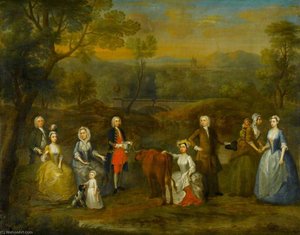
Philips’ initial artistic endeavors focused on smaller portraits and conversation pieces, styles favored by the aristocracy of the era. These works quickly gained recognition among influential patrons, establishing him as a rising talent. A particularly noteworthy piece from this formative period is his 1732 depiction of Frederick, Prince of Wales and Augusta Sophia Charlotte of Hanover for the Duchess of Portland and Duke of Somerset—a commission that showcased his burgeoning skill and cemented his position within the artistic circles of London.
Similarly impressive was “La Table Ronde,” completed in the same year. This painting captured a pivotal moment in royal life, featuring Frederick, Prince of Wales alongside prominent figures like William Walpole and Augustus FitzRoy, Duke of Grafton—a testament to Philips’ ability to convey both formality and intimacy within a single composition.
These early commissions honed Philips' mastery of technique and established him as a respected artist, laying the groundwork for his later achievements.
notable works and patrons
Philips’ career ascended to its zenith in 1737 with the creation of monumental portraits of Frederick and Augusta Sophia Charlotte—a project undertaken at considerable expense and demonstrating Philips' unwavering dedication to capturing the essence of his subjects. These canvases exemplify the grandeur and sophistication characteristic of Rococo art, reflecting the opulent tastes of the royal court.
His patrons included not only the monarchy but also numerous noble families who recognized Philips’ talent for portraying individuals with dignity and nuance. The Duke of Gloucester commissioned him to paint a portrait of his son, showcasing Philips' versatility in adapting to diverse stylistic preferences.
influence and legacy
Philips’ artistic output contributed significantly to the evolution of portrait painting during the Stuart dynasty. His meticulous attention to detail—particularly evident in his use of chiaroscuro—influenced subsequent artists who sought to emulate his masterful approach to illumination and shading.
Furthermore, Philips' work served as a catalyst for discussions about artistic representation and psychological insight—themes that would resonate throughout the Romantic era and beyond. Although his life was tragically cut short in 1747 at the age of forty-four, Charles Philips’ legacy persists as an exemplar of British Baroque artistry.
key points to remember
- Baptized in the combined parish of St Mildred, Poultry with St Mary Colechurch.
- Married to Mary Francis in 1737.
- Notable patrons include the royal family and noble figures.
Preguntas y respuestas
¿Puedo visitar un museo virtual con las obras de Carlos Philips?
Puede realizar una visita virtual: la página Galería 3D de Carlos Philips presenta las obras del artista en una galería tridimensional.
¿Qué colores utilizaba con más frecuencia Carlos Philips?
El perfil cromático de la obra de Carlos Philips se puede consultar en su página de ADN de la Paleta.
¿Cuántas obras de Carlos Philips hay disponibles para explorar?
Puede explorar 31 obras obras de Carlos Philips en la página Todas las obras de arte.