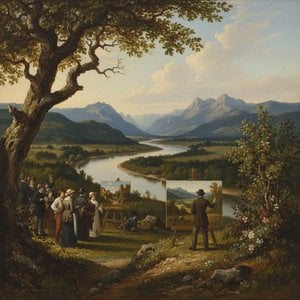
Bernard Benedict Hemy: A Chronicle of the Northumbrian Coast
Bernard Benedict Hemy (1845-1913) wasn’t a name that immediately resonates within the grand halls of art history, yet his canvases offer a remarkably intimate and compelling portrait of Victorian Britain – specifically, the rugged beauty and industrious spirit of the Northumbrian coast. Born in Australia to British expatriates, Hemy returned to England as a young man, establishing himself firmly within the artistic community of Newcastle upon Tyne, a region profoundly shaped by its maritime heritage. His work, largely overlooked for decades, now reveals itself as a significant contribution to 19th-century landscape and genre painting, capturing not just scenes but also the very essence of life along the Northumberland shoreline.
Hemy’s artistic journey was inextricably linked to his family history. His father, Charles Napier Hemy, was already an established marine painter, and his elder brother, Thomas Marie Madawaska Hemy, followed in his footsteps. This familial connection provided a crucial foundation, exposing young Bernard to the techniques and traditions of coastal painting from an early age. However, unlike his brothers who embarked on extensive travels, documenting exotic seascapes across the globe, Hemy chose to remain rooted in his native North East, dedicating himself to portraying the familiar landscapes and working-class communities that surrounded him. This deliberate choice profoundly shaped his artistic vision – a deeply personal and nuanced understanding of a specific place and its people.
A Palette of Practicality: Style and Technique
Hemy’s style is immediately recognizable for its remarkable realism and attention to detail. He eschewed the romanticized, idealized landscapes favored by some of his contemporaries, instead opting for a direct and unvarnished depiction of coastal life. His paintings are characterized by meticulous observation, capturing not just the visual elements – the shifting light on the water, the weathered faces of fishermen, the intricate rigging of boats – but also the tactile qualities of the environment: the rough texture of the cliffs, the salty tang of the air. His use of color is particularly noteworthy; he employed a muted palette dominated by blues, greys, and browns, reflecting the often-dramatic and changeable weather conditions of the Northumbrian coast. He wasn’t interested in dramatic sunsets or vibrant hues; instead, he sought to convey the quiet dignity and resilience of those who lived and worked alongside the sea.
Technically, Hemy demonstrated a mastery of oil painting, employing layering techniques to build up texture and depth. His brushwork is often loose and expressive, particularly in depicting the movement of water and wind. He frequently worked en plein air – directly from nature – allowing him to capture the fleeting effects of light and atmosphere with remarkable accuracy. This commitment to direct observation is evident throughout his oeuvre, lending a sense of immediacy and authenticity to his work.
Subjects of the Shore: Genre Scenes and Maritime Life
Hemy’s most celebrated works depict scenes of everyday life along the Northumberland coast. He was particularly drawn to portraying the fishing industry – the bustling harbors, the weathered faces of the fishermen hauling their nets, the small boats bobbing on the waves. Paintings like “Fishing Fleet at North Shields, Tyne and Wear” offer a vivid glimpse into the rhythms of coastal communities, capturing not just the physical activity but also the social interactions and traditions that defined their lives. Beyond maritime scenes, Hemy also painted portraits of local residents – farmers, shopkeepers, and laborers – often depicting them in their working clothes, further emphasizing his commitment to portraying the realities of Northumbrian life.
His work isn’t simply a record of these activities; it's imbued with a quiet empathy. Hemy seems to possess an innate understanding of the dignity and hardship of those he depicts, conveying a sense of respect for their labor and resilience. He wasn’t interested in glorifying or romanticizing poverty; instead, he presented it honestly and without sentimentality.
Notable Works and Legacy
Among Hemy's most significant paintings are “Coast Scene,” a masterful depiction of the rugged coastline near Alnmouth, and "Seascape," a captivating portrayal of maritime activity. His painting “Foundering off St Mary’s Island” is particularly noteworthy for its dramatic composition and evocative sense of atmosphere. These works, along with numerous smaller studies and portraits, now reside in collections such as the North Tyneside Council's Quadrant Gallery and are increasingly recognized for their artistic merit.
Despite his prolific output, Hemy’s work remained largely unknown until relatively recently. The rediscovery of his paintings has been a testament to the enduring appeal of his honest depictions of everyday life and the captivating beauty of the Northumbrian coast. Bernard Benedict Hemy's legacy is not one of grand ambition or revolutionary innovation, but rather of quiet observation, meticulous craftsmanship, and a profound connection to place – qualities that continue to resonate with viewers today.
Preguntas y respuestas
¿En qué periodo histórico trabajó Bernard Benedict Hemy?
Bernard Benedict Hemy trabajó durante el periodo 19th Century. Este periodo sitúa la actividad del artista en la historia.
¿Cómo puedo ver todas las obras creadas por Bernard Benedict Hemy?
Todas las obras de Bernard Benedict Hemy en este sitio web pueden explorarse desde la página de Todas las obras del artista.
¿Qué estados de ánimo expresan las obras de Bernard Benedict Hemy?
La Galería de estados de ánimo de Bernard Benedict Hemy es una página que organiza las obras del artista según el estado de ánimo.