Auguste Étienne François Mayer: A Pioneer of Arctic Marine Art
Auguste Étienne François Mayer (3 July 1805 – 22 September 1890) stands as a singular figure in the annals of French art history—a naval painter who transcended mere representation to become an explorer, scientist, and chronicler of the Arctic wilderness. Born in Brest, France, Mayer’s life was inextricably linked with the sea, shaping not only his artistic vision but also his adventurous spirit. His legacy resides primarily in his breathtaking depictions of polar landscapes interwoven with maritime scenes—a stylistic fusion that distinguishes him from his contemporaries and cemented his place as a pivotal voice in documenting the Victorian era's fascination with scientific discovery.
Early Life and Artistic Beginnings
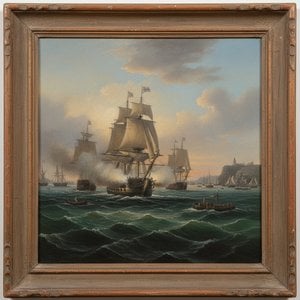
Mayer’s upbringing amidst a seafaring family instilled within him an innate appreciation for naval art, influencing his formative years. He honed his skills initially focusing on capturing the grandeur of the ocean—the turbulent waves, the luminous sunsets, and the imposing silhouettes of warships—techniques that would later inform his Arctic expeditions. This early exposure to maritime imagery undoubtedly fueled his artistic sensibilities and established a foundational understanding of composition and perspective crucial for his future endeavors.
Academic Training and Artistic Style
Mayer’s formal education at the École Navale solidified his understanding of marine engineering and naval aesthetics. His artistic style was characterized by meticulous detail, achieved through painstaking observation and masterful brushwork—a hallmark of academic painting. He prioritized realism, striving to faithfully reproduce the textures and colors of both sea and land, reflecting a commitment to scientific accuracy alongside artistic beauty. This dedication to precise rendering aligns perfectly with the ethos of the Victorian period, where scientific inquiry was paramount, mirroring the meticulous approach he adopted in his artwork.
Arctic Expeditions: Bridging Art and Science
Mayer’s participation in several Arctic expeditions—most notably the Crocker Expedition to Franz Josef Land in 1879—transformed his artistic practice. These voyages provided him with unparalleled access to the dramatic landscapes of the polar regions, fueling his creativity and inspiring a new genre of artwork. His paintings from this period are notable for their vibrant colors and dynamic compositions, capturing not just visual splendor but also conveying the palpable atmosphere of scientific exploration. The Crocker Expedition was particularly significant as it allowed Mayer to document the geological formations and wildlife of Franz Josef Land with unprecedented accuracy—a feat that elevated his artistic achievements beyond mere aesthetic pleasure. He meticulously recorded observations about rock strata, glacial movements, and animal behavior, integrating scientific data into his canvases alongside stunning depictions of the Arctic environment.
Notable Works and Recognition
Mayer’s oeuvre includes numerous marine canvases—particularly “Torghatten on the Finnmark Coast,” a monumental depiction of Norway's iconic rock formation—that exemplify his artistic prowess. This masterpiece showcases his mastery of color and texture, conveying the imposing scale and rugged beauty of the Norwegian coastline with remarkable fidelity. His works are housed in prestigious museums across Europe, including the Musée Baron Gérard in Bayeux, France, where they continue to captivate audiences with their evocative beauty and scientific precision. The enduring admiration for Mayer’s artistic vision underscores his contribution to marine art and confirms his place as a pivotal figure in documenting the Victorian era's fascination with exploration and observation.
Legacy and Influence
Mayer’s contribution to marine art is undeniable. He championed a style that combined meticulous observation with expressive brushwork—a precedent followed by subsequent generations of artists exploring the Arctic wilderness. His artistic vision served as inspiration for fellow painters, furthering the genre's development and ensuring his enduring influence on the history of art. He remains remembered not only as an accomplished painter but also as a courageous explorer who bravely ventured into uncharted territories, enriching both the visual arts and scientific knowledge with his remarkable accomplishments.