Aron Iosifovich Zinshtein: A Voice of Expressionism
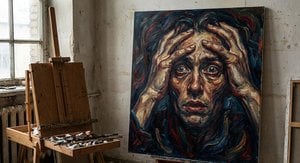
Aron Iosifovich Zinshtein (born October 13, 1947 in Nizhny Tagil, Sverdlovsk Region) stands as a prominent figure within Russian expressionist art. Born amidst the formative years of Soviet artistic experimentation, Zinshtein’s career has spanned decades marked by prolific output and international recognition—a testament to his unwavering dedication to capturing raw emotion and psychological depth through painting. His distinctive style, characterized by bold brushstrokes and emotionally charged compositions centered on the human form, distinguishes him from many contemporaries and secures his place within the canon of 20th-century art.
Early Life and Artistic Formation
Zinshtein’s artistic journey commenced with studies at the Ural School of Applied Arts in Nizhny Tagil, where he honed foundational skills in drawing and painting—skills that would prove invaluable as he progressed to the Mukhina Art Academy in Leningrad (now St Petersburg). This latter institution provided him with a more rigorous academic grounding, fostering his understanding of artistic theory and technique. Notably, Zinshtein’s membership in the Union of Artists of the USSR in 1988 solidified his position within the Soviet art establishment and signaled an embrace of its ethos—a commitment to exploring profound themes through emotive visual language. Subsequently, he joined the Academy of Contemporary Art in St Petersburg in 1994, furthering his artistic development amidst a burgeoning cultural landscape.
Style and Technique: The Human Figure at Its Core
Zinshtein’s artistic hallmark lies in his unwavering focus on portraying the human figure—often rendered with visceral intensity and imbued with psychological complexity. He eschewed prevailing trends of abstraction, prioritizing instead the direct conveyance of emotion through expressive brushwork and color palettes. His preferred mediums included gouache and dry needle, allowing him to achieve remarkable textural richness and luminosity. Lithography and linocuts were also utilized extensively in his prints, reflecting a broader artistic sensibility that encompassed diverse visual media. As Zinshtein himself eloquently stated, “I am a naive artist; I can depict everything,” encapsulating the core of his artistic philosophy—a belief in unfiltered observation and an uncompromising pursuit of emotional truth.
Exhibitions and Recognition: A Global Presence
Zinshtein’s work has garnered considerable acclaim both domestically and internationally. He participated in numerous exhibitions across Russia, Europe, and the United States, showcasing his distinctive vision to audiences worldwide. His paintings reside within prestigious institutions such as the Russian State Museum in St Petersburg, the Fyodor Dostoevsky Museum in St Petersburg, the Russian National Library in St Petersburg, the Kiev Museum of Russian Art, the Bristol Museum in the UK, and are held by private collectors across continents—a tangible reflection of his enduring artistic legacy. Furthermore, Zinshtein’s prints adorn the walls of museums and galleries globally, cementing his reputation as a master of printmaking alongside his celebrated paintings.
Notable Works and Legacy
Among Zinshtein's most recognizable pieces are “Football” and “Metro. Escalator,” which exemplify his masterful ability to capture fleeting moments of human experience with arresting immediacy. These works stand out for their dynamic compositions, vibrant colors, and evocative portrayal of psychological states—characteristics that resonate deeply with viewers and underscore the artist’s profound engagement with existential themes. Zinshtein's artistic output has been lauded by critics and curators alike, who recognize his contribution to expressionist art and his unwavering commitment to exploring the complexities of human emotion. His enduring influence can be discerned in subsequent generations of artists—a testament to his pioneering spirit and his indelible mark upon the history of Russian art.