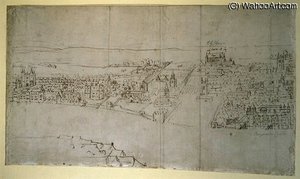
Anthonis van den Wyngaerde: Chronicler of Renaissance Cities
Anthonis van den Wyngaerde (c. 1525-1571) stands as a singular figure in Flemish art history—a master of topographical drawing who captured the grandeur and complexity of European cities during the High Renaissance with unparalleled precision and artistic vision. Unlike many of his contemporaries focused on idealized portraits or mythological narratives, Wyngaerde dedicated himself to documenting the physical realities of urban landscapes, producing panoramas that serve as invaluable windows into the social, political, and cultural life of Spain, England, and Italy.
His work represents a profound departure from prevailing artistic trends—a conscious rejection of decorative conventions in favor of intellectual rigor and observational accuracy. He wasn’t merely aiming to depict places; he sought to convey their essence, capturing not only architectural details but also the rhythms of daily life within bustling urban centers. This ambition distinguishes him as one of the foremost artists of his era, securing his place among the pioneers of topographical art.
Early Life & Training
Born around 1525 in Antwerp—a vibrant hub of artistic activity during the Renaissance—Wyngaerde’s formative years coincided with a period fueled by patronage from wealthy merchants and noble families. Biographical details remain scarce—likely due to the turbulent political climate of his time—but evidence suggests he studied under Pieter Bruegel the Elder, absorbing Bruegel's distinctive style characterized by earthy realism and symbolic storytelling. This influence is palpable in Wyngaerde’s meticulous attention to detail and his ability to infuse his drawings with subtle emotional resonance. The Elder’s approach to portraying human figures—often imbued with moral lessons—served as a crucial precedent for Wyngaerde’s own artistic endeavors.
The Panorama Phenomenon: A Revolutionary Vision
Wyngaerde’s fame rests primarily on his ambitious panoramic sketches, particularly “The Tower” depicting London Bridge and “London Bridge - From The London Panorama,” commissioned for the Royal Society of London in 1567. These monumental canvases—measuring approximately 3.8 x 7 meters—represent a radical departure from traditional artistic conventions. Rather than striving for aesthetic beauty alone, Wyngaerde meticulously rendered architectural details, street layouts, and even human activity with astonishing accuracy. He achieved this feat through a groundbreaking technique combining watercolor washes with meticulous penwork—a method that allowed him to achieve remarkable tonal gradations and textural effects. This innovative approach wasn’t merely about replicating visual appearances; it was about constructing a comprehensive representation of urban space, conveying information about its topography, commerce, and social dynamics. The sheer scale of these panoramas underscored Wyngaerde's conviction that art could serve as a tool for understanding the world around him—a belief that resonated deeply with humanist thinkers of his time.
Technique & Style: Mastering Perspective and Detail
Wyngaerde’s technique was revolutionary for its time, fundamentally altering the landscape of topographical drawing. He employed a layered approach combining watercolor washes with meticulous penwork—a method that allowed him to achieve remarkable tonal gradations and textural effects. This painstaking process demanded immense patience and precision, reflecting Wyngaerde's unwavering commitment to artistic excellence. His drawings weren’t merely representations of places; they were careful reconstructions designed to convey not only visual information but also a sense of atmosphere and perspective—a feat accomplished through the skillful manipulation of linear perspective. Furthermore, Wyngaerde’s meticulous attention to detail—capturing every brick, cobblestone, and human figure—established him as an unparalleled master of observational realism.
Notable Achievements & Legacy
Wyngaerde's contribution to art history extends beyond his technical innovations; he embodies a humanist impulse—a desire to understand and portray the world around him with intellectual rigor and artistic sensitivity. His panoramas continue to fascinate scholars and artists alike, offering insights into Renaissance urban culture and demonstrating the power of visual representation to communicate complex ideas about space, time, and human experience. The rediscovery of his work in recent decades has reaffirmed its significance as a pivotal achievement in topographical art—a testament to Wyngaerde’s visionary approach and enduring artistic legacy. His drawings stand as invaluable records of Elizabethan London, capturing the spirit of an era defined by exploration, innovation, and intellectual curiosity.