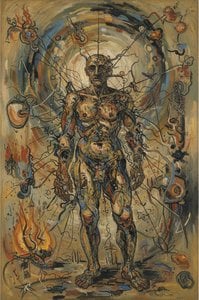
André Fermigier: A Voice for Impressionism and Beyond
André Fermigier (1923 – 1988) was a French art historian, critic, and journalist whose meticulous scholarship and passionate prose cemented his place as one of the foremost interpreters of Impressionist painting. Born in Paris on August 22nd, he embarked upon a distinguished academic career, earning an agrégation de lettres classiques—a prestigious qualification signifying excellence in classical literature—which propelled him into teaching positions across Europe, fostering connections with influential figures like Bernard Berenson and Roberto Longhi. These formative experiences instilled within him not only a profound understanding of artistic history but also a distinctive approach to communicating its complexities to discerning audiences.
Early Life & Education
Fermigier’s intellectual curiosity blossomed early, fueled by a love for literature and a dedication to mastering the classics. His agrégation provided a solid foundation for his subsequent pursuits in art history, shaping his analytical skills and fostering a lifelong fascination with artistic movements and their cultural contexts. He possessed an innate talent for observation—a skill honed during his formative years—that would prove invaluable throughout his academic journey.
Teaching Career
Fermigier lectured at Reims University, Alexandria University, Copenhagen University, and Florence University, immersing himself in diverse academic environments and engaging with fellow scholars who championed innovative interpretations of art. This international exposure broadened his perspectives and honed his ability to synthesize complex ideas into accessible narratives. He cultivated relationships with luminaries like Bernard Berenson and Roberto Longhi—artists whose stylistic sensibilities profoundly influenced Fermigier’s own artistic vision.
A Critical Eye: Writings & Artistic Reputation
Fermigier established himself as a respected voice in the Parisian art world through his prolific contributions to publications such as Le Monde and L'Observateur. His writing style—characterized by clarity, precision, and an unwavering commitment to intellectual rigor—earned him acclaim for illuminating artistic debates and fostering informed discussions about aesthe tic values. However, Fermigier’s career wasn’t without controversy; he famously clashed with fellow artists and intellectuals over differing viewpoints on artistic interpretation, demonstrating a spirited defense of his convictions. His meticulous analyses of Impressionist paintings captivated audiences and solidified his reputation as a formidable intellectual force.
The Art of Observation: Millet & Beyond
Fermigier’s artistic sensibilities extended beyond scholarly pursuits; he possessed a remarkable talent for capturing the essence of visual art through lithography prints, notably his masterful depiction of Jean-François Millet's “The Gleaners.” This print exemplifies Fermigier’s ability to distill complex ideas into evocative imagery—a skill honed during his studies with Berenson and Longhi—and underscores his appreciation for the expressive power of artistic representation. The artwork resides in the Grohmann Museum in Milwaukee, United States. He championed the preservation of cultural heritage, particularly Parisian landmarks threatened by urban development projects undertaken between 1965 and 1972. Fermigier’s unwavering dedication to intellectual rigor and artistic discernment ensured his place as a pivotal figure in shaping our understanding of 19th-century visual culture.
### Further Exploration
For more detailed information on André Fermigier's life, work, and contributions to art history, please visit André Fermigier’s page on WahooArt:
https://www.WahooArt.com/andre-fermigier/. You can also delve deeper into the Musée Maurice Denis collection, which houses a remarkable assemblage of French Impressionist paintings from
https://www.WahooArt.com/musee-jacquemart-andre/.