Amelia Peláez Del Casal (1896 – 1968): A Pioneer of Cuban Modernism
Amelia Peláez del Casal stands as a monumental figure in the history of Cuban art, recognized as one of the foremost representatives of the avant-garde generation that emerged during the tumultuous years following the Cuban Revolution. Born in Havana, Cuba, on January 5th, 1896, into a family rooted in Creole middle-class traditions—her father, Manuel Pelaez y Laredo, was a physician, and her mother, Maria del Carmen del Casal y Lastra, remained at home nurturing their children—Peláez’s formative years were marked by exposure to intellectual currents that would profoundly shape her artistic vision.
Early Life & Education: The Seeds of Artistic Vision
Amelia’s upbringing instilled in her a deep appreciation for culture and learning. Her uncle Julian del Casal, a celebrated poet, fostered an environment rich in literary discourse, introducing her family to the vibrant intellectual landscape of Havana. Notably, she enrolled at San Alejandro Academy at the relatively late age of 20, defying societal expectations for women’s education during that era—a decision influenced by her mother's dedication to nurturing her children and a desire to pursue artistic pursuits independently. This bold step demonstrated an unwavering commitment to intellectual exploration and solidified her determination to forge her own path in the realm of art.
Parisian Influences: Embracing Avant-Garde Ideals
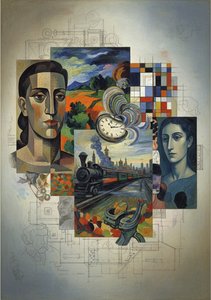
Recognizing the importance of formal training, Peláez embarked on a transformative journey to Paris in 1927, supported by a government grant. Accompanied by fellow artist Lydia Cabrera, she immersed herself in the Parisian art scene, attending classes at École Nationale Supérieure des Beaux-Arts and École du Louvre alongside luminaries like Fernand Léger and Alexandra Exter. This period exposed her to diverse artistic styles—particularly Constructivism and Surrealism—which challenged traditional conventions and broadened her creative horizons. The influence of these movements is palpable in her later works, where geometric abstraction blends seamlessly with meticulous observation of the natural world.
Style & Technique: A Synthesis of Observation and Abstraction
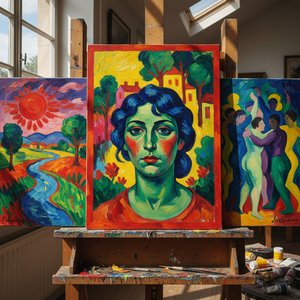
Peláez’s distinctive aesthetic is characterized by a masterful blend of abstraction and meticulous observation. Her paintings frequently depict still lifes rendered in muted tones—often dominated by earthy hues—capturing the essence of Cuban flora and fauna with remarkable precision. However, unlike many of her contemporaries, she eschewed purely representational approaches, favoring instead stylized forms that conveyed emotion and atmosphere. She skillfully manipulated color palettes—often employing complementary hues—to create visually arresting surfaces that drew inspiration from both Cézanne and Picasso. Her brushwork is deliberate and controlled, conveying a sense of quiet contemplation while simultaneously capturing the dynamism inherent in her subjects.
Notable Achievements: Recognition on the International Stage
Peláez’s artistic legacy extends beyond her individual oeuvre. Her inclusion in Alfred H. Barr Jr.’s groundbreaking exhibition “Modern Cuban Painters” at MoMA in 1944 cemented her place as a pivotal figure in establishing Cuban art on the international stage. The exhibition garnered considerable acclaim, showcasing Peláez's work alongside other prominent artists of the era and solidifying her reputation as a champion of modernist ideals within Cuba’s artistic community. This momentous recognition underscored the significance of her contribution to shaping perceptions of Cuban art globally.
Legacy & Significance: An Enduring Influence
Amelia Peláez del Casal’s contribution to Cuban art transcends mere stylistic innovation; she embodies the spirit of intellectual curiosity and artistic courage that defined the avant-garde movement. Her unwavering commitment to exploring new visual languages—coupled with her profound engagement with cultural traditions—continues to inspire artists today, ensuring her enduring influence on Cuban artistic history. She remains a beacon of creativity and perseverance, reminding us that art possesses the power to transcend boundaries and illuminate the complexities of human experience.