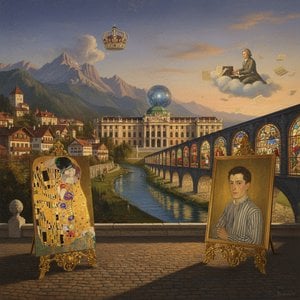
Alexander Zemlinsky: Bridging Romanticism and Modernism
Alexander von Zemlinsky (14 October 1871 – 15 March 1942) stands as a pivotal figure in Austrian musical history, representing the fascinating confluence of late Romanticism and the burgeoning innovations of the Second Viennese School. Born in Vienna, Austria, Zemlinsky’s life was dedicated to mastering both tradition and experimentation—a pursuit that cemented his place among the most influential composers of his era.
Early Life and Musical Formation
Zemlinsky's formative years were spent at the Vienna Conservatory, where he received instruction from luminaries like Anton Bruckner and Gustav Mahler. Crucially, his friendships with Arnold Schoenberg and Mathilde Schoenberg—who would later marry Zemlinsky’s sister—established a network of intellectual exchange that profoundly shaped his artistic vision. Schoenberg's pioneering explorations into atonality and twelve-tone music directly impacted Zemlinsky’s compositional approach, fostering a willingness to challenge established harmonic conventions.
Musical Contributions and Legacy
Zemlinsky’s musical output is characterized by its remarkable blend of stylistic elements. He excelled as an opera composer, crafting works that explored psychological depth and dramatic nuance—most notably *Elektra*, which remains a cornerstone of modern operatic repertoire. However, his symphonic achievements are equally noteworthy, particularly *Verklärte Nacht* (1899), a haunting string sextet considered one of the earliest examples of orchestral atonality. Zemlinsky’s mentorship extended to younger composers like Alban Berg and Anton Webern, who embraced Schoenberg's techniques and established themselves as central figures in the Second Viennese School—a movement that irrevocably transformed musical aesthetics.
Notable Collaborations and Influences
Zemlinsky’s artistic journey was inextricably linked with collaborative endeavors. His partnership with Schoenberg resulted in groundbreaking explorations of tonal dissonance, pushing the boundaries of harmonic language. Furthermore, Zemlinsky's influence permeated the works of Berg and Webern, shaping their distinctive musical voices and contributing to the development of a uniquely expressive idiom.
A Rediscovered Master
Today, Zemlinsky’s music continues to resonate with audiences worldwide—a testament to his enduring artistic legacy. His contributions to Viennese musical culture are commemorated in institutions like the Kunstsammlungen und Museen Augsburg, where visitors can immerse themselves in the rich tapestry of art history and appreciate Zemlinsky's profound impact on the evolution of musical thought. Explore WahooArt’s comprehensive collection to delve deeper into his artistic achievements and discover the enduring beauty of his compositions.