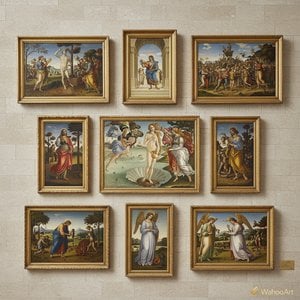
Alesso di Benozzo: A Florentine Master of Devotion and Detail
Alesso di Benozzo (1473-1528), Italian Renaissance painter & son of Benozzo Gozzoli, stands as a testament to the artistic dynamism of Florence during its golden age. Though overshadowed by his father’s monumental achievements—particularly the Magi Chapel frescoes—Alesso carved out a distinguished career marked by meticulous craftsmanship and profound spiritual sensitivity. His legacy resides primarily in his devotional paintings and altar pieces, which exemplify the humanist ideals of beauty and clarity that characterized the era.
Early Life and Artistic Training
Born in Pisa around 1473, Alesso’s artistic lineage was undeniably influential. His father, Benozzo Gozzoli, a celebrated Florentine painter known for his opulent frescoes—most notably the Magi Chapel—established a workshop where Alesso received invaluable training from an early age. This familial connection fostered a shared stylistic vision characterized by refined elegance and a masterful command of color and composition. Art historians have debated whether Alesso’s style was entirely independent or heavily influenced by his father's artistic sensibilities, but evidence suggests that he possessed considerable talent and developed a distinctive approach to painting. The attribution of the “Maestro delle Figure Esigue” nickname—invented by Roberto Longhi—highlights Alesso’s penchant for portraying figures with exceptional delicacy and precision. He absorbed the lessons of his father, mastering techniques honed over decades of experience and inheriting a deep understanding of Florentine artistic traditions.
Notable Works and Artistic Style
Alesso’s artistic output spanned across several prominent commissions, demonstrating his versatility as a painter. Following his father's untimely death in 1497, he undertook the ambitious task of completing the Maestà of Palazzo Comunale in Pistoia alongside Francesco Gozzoli—a collaborative effort that cemented their reputation for excellence. This monumental fresco cycle showcased Alesso’s skill in capturing expressive gestures and conveying profound emotion through subtle nuances of color and shading. The Maestà exemplifies the stylistic fusion characteristic of Florentine art during this period, blending Gothic International influences with Renaissance ideals of harmony and proportion. Furthermore, he undertook numerous smaller devotional paintings depicting scenes from the Virgin Mary's life, including “The Annunciation” (Metropolitan Museum of Art), “The Crucifixion” (Boston Museum of Fine Arts), “The Deposition of Christ” (Tulsa Philbrook Museum of Art) and two panels of “The Man of Sorrows” (Princeton University Art Museum & Geneva Musée d’art et d’histoire). These works exemplify Alesso's meticulous attention to detail and his ability to imbue biblical narratives with spiritual resonance. His altarpieces, such as “Visitation” in Castelfiorentino, further solidified his reputation for artistic excellence.
Influence and Legacy
Alesso di Benozzo’s contribution to Renaissance art is significant not only for its aesthetic qualities but also for its embodiment of humanist ideals. Like his father, he was a member of the Florentine confraternity of Saint Luke—a vital institution fostering artistic innovation and spiritual devotion. His work reflects the prevailing stylistic trends of the period—particularly the International Gothic style—characterized by luminous colors, graceful figures, and intricate decorative elements. Despite being largely unrecognized during his lifetime, Alesso’s paintings continue to captivate audiences today, serving as enduring reminders of Florence's artistic brilliance and its profound engagement with religious themes. His legacy resides in his ability to convey spiritual contemplation through visual beauty—a testament to the enduring power of art to inspire awe and reverence. He is remembered as a master craftsman who elevated devotional painting to new heights, ensuring that his work would resonate across centuries.
Further Exploration
To delve deeper into Alesso di Benozzo’s artistic achievements, explore resources such as: