Adolph von Menzel: The Titan of Prussian Realism
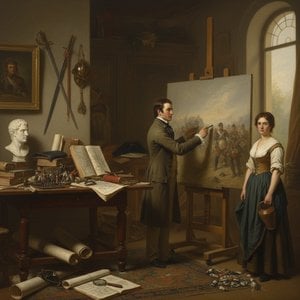
Adolph Friedrich Erdmann von Menzel (1815-1905) stands as one of the undisputed giants of German Romantic and Realist painting, alongside Caspar David Friedrich. Born in Breslau (now Wrocław), Prussia, into a family steeped in lithography—his father actively engaged in the craft—Menzel’s artistic trajectory was shaped by an early fascination with drawing and etching, nurtured not solely by familial tradition but also by a profound engagement with literature and philosophy. He wasn't merely a painter; he was a meticulous observer of human experience, translating his perceptions onto canvas with unparalleled accuracy and emotional depth.
Early Life & Education: A Foundation in Observation
Menzel’s formal education began at the Berlin Academy of Art in 1833, where he honed his skills studying plaster casts and ancient sculptures. However, unlike Friedrich, who embraced a solitary intellectual path, Menzel pursued self-education with unwavering determination, immersing himself in artistic experimentation and absorbing influences from diverse sources. This dedication to independent study proved crucial—allowing him to develop a distinctive style characterized by painstaking detail and psychological insight. His father’s involvement in lithography instilled within him an appreciation for precision and dissemination of visual ideas – values that would permeate his entire oeuvre.
Lithographic Beginnings & Goethe’s Influence: Shaping Aesthetic Sensibilities
His debut work, an album of pen-and-ink drawings reproduced on stone to illustrate Goethe's poem “Kunstlers Erdenwallen,” established him as a masterful lithographer—a skill that would serve him throughout his career and contribute significantly to the dissemination of his artistic vision. Goethe’s poetic exploration of nature profoundly impacted Menzel’s aesthetic sensibilities, fostering an appreciation for detail and capturing the essence of the natural world. This influence is palpable in many of his landscapes, where he strives to convey not just visual beauty but also a deeper understanding of the interconnectedness between humanity and environment. The meticulous process of lithography itself demanded patience and precision—qualities that mirrored Menzel’s artistic temperament.
The Masterpiece: Frederick the Great
Menzel's magnum opus, “History of Frederick the Great” (1840), cemented his reputation as a historian painter of unparalleled ambition and accuracy. Comprising approximately 400 meticulously crafted illustrations—a monumental undertaking for its time—the series depicts pivotal moments in Frederick II’s reign with breathtaking realism and psychological insight. Menzel's dedication to historical research ensured that every depiction adhered rigorously to documented facts, elevating the project beyond mere artistic representation into a scholarly endeavor. He painstakingly researched costumes, architecture, and weaponry, striving for an unprecedented level of authenticity—a testament to his commitment to conveying history truthfully and powerfully. The sheer scale of this project demanded innovative printing techniques – showcasing Menzel’s collaborative spirit and willingness to embrace technological advancements.
Beyond Grand Narratives: Capturing Everyday Life
While “Frederick the Great” secured his place in art history as a monumental achievement, Menzel’s artistic legacy extends far beyond grand historical narratives. He excelled at capturing the mundane realities of daily life—scenes from Prussian society, industrial landscapes, and intimate portraits—demonstrating an extraordinary ability to convey emotion and atmosphere with understated elegance. Artists like Degas admired Menzel’s ability to convey emotion through subtle gestures and expressions, recognizing in him a kindred spirit who prioritized truthfulness and psychological nuance above stylistic convention. Notable works include “The Tuileries,” portraying Parisian bourgeois life with remarkable detail, and “El Recostamiento de los Caídos de Marzo,” depicting the turbulent atmosphere of the Berlin Revolution.
Legacy & Influence: An Enduring Vision
Adolph von Menzel's influence on subsequent generations of German artists is undeniable. His unwavering commitment to realism, coupled with his profound understanding of human psychology and his meticulous attention to detail—traits that defined his artistic practice—established him as a model for aspiring painters. His paintings reside prominently in museums across Germany—including the Kunstsammlungen und Museen Augsburg and Museo Civico Giovanni Fattori—serving as enduring reminders of his artistic genius. Menzel’s work continues to inspire admiration for its uncompromising honesty and its profound engagement with the human condition, securing his place among the most significant figures in German art history. He remains a beacon of artistic integrity – demonstrating that true artistry lies in capturing the complexities of life with unwavering observation and empathetic understanding.