The Pulse of Progress: Steam, Energy, and the Shift in Power
The mid-18th century marked a departure from the rhythms of the natural world, a moment when human ingenuity began to harness the latent energy of the earth. In Great Britain, the extraction of coal from the depths of Wales and County Durham provided the fuel for a transformation that would eventually reshape the global landscape. This was the era of the steam engine, a device that transitioned industry from a reliance on the seasonal flow of water and the physical limits of animal muscle to the relentless, predictable force of combustion. Thomas Newcomen’s first successful engine in 1712 laid the groundwork, but it was James Watt’s 1769 patent for the modern, rotating shaft engine that truly set the gears of the world in motion. This shift in power was not merely a technical achievement; it was a fundamental change in the human relationship with energy. As steam replaced water as the primary driver of industry, the landscape itself began to change, populated by the silhouettes of chimneys and the constant movement of locomotives. The transition from the organic to the mechanical was a profound metamorphosis, a second metaparadigm that prioritized the transformation of energy to drive mass production. Today, we live in the wake of this shift, where the legacy of that early energy distribution is felt in every facet of our modern, electrified existence.The Human Element: Witnessing the Scale of Industrial Labor
As the machines grew in scale, the individuals operating them often seemed to shrink in comparison. The early 20th century provided a stark visual record of this disparity, particularly within the textile industries of the American South. In the photographs of Lewis Hine, specifically his 1908 documentation of cotton-mill workers in North Carolina, we find a quiet, somber encounter with the human cost of progress. One image captures a young girl, perhaps no older than twelve, framed by the relentless, geometric repetition of a cotton loom. Her presence is a silent witness to a reality that was often obscured from the public eye: the grueling, repetitive labor of children earning mere cents a day. This documentation serves as a vital link to the social consequences of rapid industrialization. Hine’s work did more than record a scene; it provided the visual evidence required to spark significant legislative change regarding child labor. The contrast between the smooth, vulnerable skin of a child and the rough, unyielding surfaces of the spinning frames highlights the tension inherent in the industrial age. It reminds us that behind every statistic of production lies a lived experience, a human story of endurance amidst the overwhelming scale of the machine.Mechanical Rhythms: Cubism and the Geometry of the Machine Age
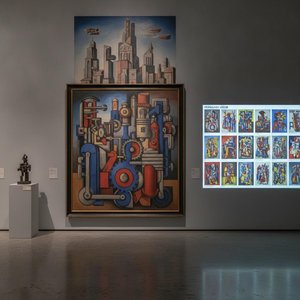
 Fernand Léger
. French Cubist known for Tubism and rhythmic, mechanical forms inspired by the machine age and the vibrant neon lights of New York City.
Steel and Structure: The Architectural Legacy of the Railway
The expansion of the railway redefined the boundaries of human movement, turning distant cities into interconnected hubs of commerce and culture. In places like Doncaster, the ascent of the region as a global center for railway engineering is celebrated through the preservation of magnificent locomotives. These iron monuments, such as the Great Northern Railway C1 class, are more than mere transport; they are the physical embodiment of Victorian innovation. They represent a time when steam and steel allowed humanity to conquer distance, creating a sense of grandeur that was both functional and awe-inspiring. This era of engineering left a permanent mark on the built environment, where the strength of cast iron and the precision of steel became the new standard for public spaces. The Birmingham Museum & Art Gallery, for instance, stands as a soaring example of this period, featuring architecture designed by Yeoville Thomason that utilizes cast-iron to create a sense of permanence and civic pride. The railway did not just move people; it moved ideas, facilitating the spread of the Industrial Revolution across Continental Europe and North America, and forever altering the geography of the modern nation-state.The Hand and the Machine: From Manual Craft to Digital Precision
 DASA Working World Exhibition
Explore DASA Dortmund's immersive exhibition showcasing the evolution of labor – from industrial heritage to future technologies! Interactive learning stations and stunning architecture await visitors.