Introduction To step into a gallery of mixed media is to witness the moment art broke free from the constraints of a single medium. For centuries, the boundaries of the canvas were strictly defined by the limits of oil, tempera, or fresco. But there ...
The history of modern art is often defined by moments of profound rupture, where established boundaries are shattered to allow for a new perception of reality. For centuries, the sanctity of the canvas was maintained through a strict adherence to singular mediums—oil, temperle, or fresco. However, around 1912, a fundamental reexamination of the relationship between painting and sculpture began to take shape in the studios of Paris. Pablo Picasso and Georges Braque introduced what would become known as papier collé, a technique where the addition of paper, cloth, and even rope challenged the very definition of a painting.
This era was not merely a technical novelty; it was a seismic shift in how we perceive depth. By introducing external fragments, these visionaries allowed the artwork to collide with the surface plane, creating a palpable tension between the depicted image and the physical reality of the materials used. Picasso’s 1912 work, Still Life with Chair Caning, serves as a primary reference point for this revolution. By utilizing oilcloth that imitated chair caning and framing the piece with actual rope, he forced the viewer to confront the work as both a representation and a literal object. This method of construction—building up rather than breaking down—marked the transition from Analytic to Synthetic Cubism, forever altering the trajectory of Western art.
Assemblage is an artistic form or medium usually created on a defined substrate that consists of three-dimensional elements projecting out of or from the substrate. It is similar to collage, a two-dimensional medium. It is part of the visual arts and...
If collage represents the art of the two-dimensional surface, then assemblage is its inevitable progression into the third dimension. While collage remains a celebrated medium of flat layers, the evolution of the form naturally pushed toward the physical projection of elements from a substrate. This transition allowed artists to move beyond the plane and inhabit the space occupied by the viewer. The term itself finds its roots in the early 20th century, though practitioners like Marcel Duchamp and Jean Arp had been experimenting with found objects long before the nomenclature was formalized.
This movement toward three-dimensional construction found a profound voice in the work of Louise Nevelson, who began creating sculptures from found pieces of wood in the late 1930s. Her ability to transform discarded fragments into cohesive, monochromatic structures mirrors the way later artists would use the physical weight of objects to command a room. Today, this lineage continues through works that utilize varying textures and depths, such as the Dimensional Mosaic Wall Art – Modern Mixed Media Composition. In such pieces, the arrangement of elements creates a visual flow that transitions from concentrated density to an airy sparseness, much like the early Cubist constructions that first invited the eye to move across a surface rather than merely through it.
Subversive Fragments: Dadaism and the Art of Disruption
A Chaotic Symphony: Exploring Max Ernst’s Collage This compelling collage by Max Ernst is a quintessential example of his pioneering work within Dada and Surrealism. It's not merely an assemblage of images; it’s a visual manifesto, challenging conven...
The arrival of the Dada movement introduced a more radical, often political, dimension to the use of fragmented materials. For the Dadaists, collage was not just an aesthetic choice but a tool for protest against the societal upheaval following World War I. They rejected traditional notions of beauty, opting instead for the irrational and the absurd. Max Ernst, a pivotal figure bridging Dada and Surrealism, utilized collage as a visual manifesto, meticulously cutting and pasting disparate elements like photographs and printed text to create a world of fragmented realities.
This spirit of disruption is echoed in the works of Hannah Höch, who used photomontage to critique gender norms, and Kurt Schwitters, whose Merz technique proved that no material was too humble for art. Schwitters demonstrated that even scavenged scraps could find a place within a deliberate composition. This legacy of using the "found" to challenge the "formal" remains a cornerstone of the medium. When we observe the complex, layered textures in contemporary works, we are seeing the descendants of this Dadaist rebellion—a refusal to accept the polished surface in favor of the raw, the torn, and the unexpected.
The Architecture of Layers: Texture as a Sensory Dialogue
The Soul of Texture: Defining Mixed Media for the Modern Collector Mixed media In visual art, mixed media describes artwork in which more than one medium or material has been employed. Assemblages, collages, and sculpture are three common examples of...
Beyond the historical movements lies the fundamental allure of the medium: the tactile revolution. For the discerning collector, the true value of mixed media often resides in its ability to transcend the visual and engage the sense of touch. The physical topography of a piece—the way light catches a raised layer of impasto or how a torn edge casts a subtle shadow—offers a sensory intimacy that pure digital imagery cannot replicate. This is the architecture of layers, where meaning is found in the friction between different substances.
This tactile depth is evident in the works of artists like Claus Mroczynski, who layered photographs, painted elements, and found objects to create complex, multi-layered compositions that suggest a dialogue between memory and reality. Similarly, the work of Trenton Doyle Hancock utilizes layers of paper and fabric to build rich textures that invite close inspection. Whether it is the use of vintage maps or the incorporation of industrial materials, the goal remains the same: to create a sense of history embedded within the very fibers of the artwork. The physical presence of these layers demands an intimate engagement, turning the act of viewing into a process of discovery.
Reclaiming the Discarded: Contemporary Narratives in Mixed Media
Santanu Dey: Sculptor of Urban Decay and Ecological Concern Santanu Dey is an Indian artist whose compelling mixed media artworks, notably ‘Untitled,’ explore themes of environmental degradation and the impact of urbanization on human existence. Born...
In the contemporary landscape, the use of collage and assemblage has evolved into a powerful vehicle for addressing urgent global narratives. Modern artists are increasingly looking toward the debris of our era—e-waste, industrial remnants, and urban detritus—to communicate themes of environmental degradation and the impact of consumerism. The artist Santanu Dey, for instance, repurposes discarded materials like aluminum litho-plates and e-waste to create sculptural forms that embody both fragility and resilience. His minimalist aesthetic uses the starkness of these materials to reflect the desolation of modern urban landscapes.
This practice finds a spiritual counterpart in the collections of institutions like Souls Grown Deep, where artists such as Thornton Dial and Lonnie Holley utilize repurposed objects to construct monumental narratives of justice and perseverance. These works transform the discarded into something profound, much like the Gee’s Bend quilts that celebrate resourcefulness through geometric abstraction. As we continue to navigate an age of digital saturation, the physical depth and material truth of mixed media serve as a vital reminder of our connection to the tangible world. At WahooArt.com, we remain dedicated to preserving this legacy of craftsmanship, offering works that honor the profound complexity found within the layers of our reality.
Master the art of layering with our trend-driven guide to modern collage. Explore high-impact mixed media techniques, from Cubist roots to contemporary street art aesthetics, and learn how to curate bold, textured masterpieces for your urban space.
Dive into the raw chaos of Dadaism. Explore how rebels like Marcel Duchamp used anti-art, readymades, and pure provocation to crash the system and redefine modern visual culture forever.
Master the complexities of Cubism with our expert guide. Explore the revolutionary fragmentation of Picasso and Braque, from Analytic to Synthetic styles, and learn how to evaluate these profound modernist masterpieces for your private collection.
¡Hola! Puedo ayudarte a elegir una obra de arte, realizar el seguimiento de un pedido o resolver tus dudas sobre la garantía. ¿En qué puedo ayudarte hoy?



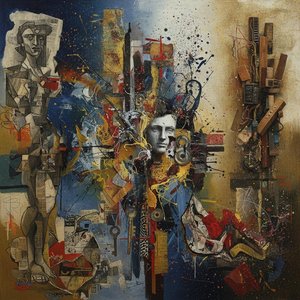 10 Iconic Mixed Media Masterpieces That Redefined Modern Art
 Assemblage (art)
 Collage
 Beyond the Brush: An Expert Collector's Guide to Exploring the Tactile World of Mixed Media Art
 Santanu Dey


