The Painting and Its Artist
Paul Cézanne, a French painter, is renowned for his pivotal role in the transition from 19th-century Impressionism to early 20th-century Cubism. His work, characterized by repetitive brushstrokes and an emphasis on structure, laid the groundwork for avant-garde movements. “Flowers in a Blue Vase,” created in 1875, is one of his notable works that exemplify his unique style. It’s considered a cornerstone of Post-Impressionism—a movement born from dissatisfaction with Impressionist aesthetics and fueled by a desire to explore deeper artistic concepts. Cézanne's meticulous observation of nature combined with an innovative approach to representation profoundly influenced subsequent generations of artists.
Artistic Style and Technique
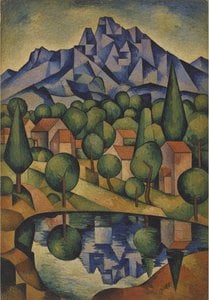
This painting is a quintessential example of Post-Impressionism, a movement that emerged as a reaction against the naturalistic depiction of light and color in Impressionist art. Cézanne’s use of planes of color and small brushstrokes creates complex fields, giving the painting a dynamic and expressive quality. Unlike Impressionists who sought to capture fleeting moments of visual sensation, Cézanne prioritized conveying underlying geometric forms—the vase itself is rendered as a series of interlocking cubes and cylinders—a technique that foreshadowed Cubism’s fragmentation of perspective. The artist's deliberate layering of paint creates textural richness and contributes to the overall sense of solidity and permanence.
Historical Context
In 1875, Cézanne was still developing his style. His early works were influenced by Romanticism and Realism, but he soon moved towards a more innovative approach. This painting reflects his intense study of subjects and his emphasis on the underlying structure of objects. Cézanne’s artistic vision coincided with a period of intellectual ferment in France—the rise of Symbolism and Nietzsche's critique of traditional morality challenged prevailing cultural assumptions. The Impressionist movement had already begun to lose its momentum, paving the way for artists like Cézanne to experiment with new forms of expression.
Reception and Legacy
Initially, Cézanne’s work was met with incomprehension and ridicule. Critics dismissed it as crude and lacking in finesse, arguing that it abandoned Impressionist ideals of beauty and spontaneity. However, fellow artists like Camille Pissarro and art dealer Ambroise Vollard recognized his genius. They championed Cézanne's vision and defended his uncompromising pursuit of artistic truth—a stance that contrasted sharply with the prevailing aesthetic sensibilities of the time. The first solo exhibition of his works in 1895 at Vollard’s gallery marked a turning point in his career, attracting considerable attention from collectors and establishing him as a leading figure in the burgeoning avant-garde scene. Henri Matisse and Pablo Picasso acknowledged Cézanne as “the father of us all,” recognizing his profound influence on their own artistic development.
Current Location and Significance
“Flowers in a Blue Vase” is housed at the State Hermitage Museum in Russia, a testament to its enduring importance. This painting, alongside others by Cézanne—particularly *Mont Sainte-Victoire*—continues to inspire artists and art enthusiasts worldwide. Its exploration of form and color remains remarkably relevant today, demonstrating the power of art to transcend time and communicate universal human emotions. For those interested in exploring more of Cézanne’s works, Paul Cézanne: Flowers in a Blue Vase and Paul Cézanne: Still Life with Curtain and Flowered Pitcher are available at WahooArt.com – offering exceptional reproductions that capture the essence of this seminal masterpiece.
- Post-Impressionism Art Movement: A predominantly French movement that developed roughly between 1886 and 1905, characterized by a reaction against Impressionists’ concern for the naturalistic depiction of light and color. Learn more about Post-Impressionism.
- Paul Cézanne's Biography: A French painter who introduced new modes of representation and influenced avant-garde artistic movements. Read more about Paul Cézanne on Wikipedia.
- History of Art: The history of art focuses on objects made by humans for various purposes, with a primary emphasis on their aesthetic visual form. Explore the History of Art on Wikipedia.
This article provides an in-depth look at “Flowers in a Blue Vase” by Paul Cézanne, highlighting its significance within the Post-Impressionist movement and its enduring influence on modern art.



 Vista previa
 Cambiar a formato impreso
 Compartir
 Compartir
 Ver detalles
 Guía
Guía

 Descargar
 Ver artículos similares
 Radiografía
 Presentación de diapositivas
 Estadísticas

 Leer más






































 La opción de vidrio solo está disponible en tamaños inferiores a 110 cm.