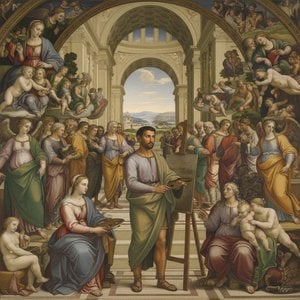
Raphael: A Titan of Renaissance Grace
Raphael Sanzio da Urbino stands as one of the undisputed masters of the High Renaissance—a period defined by an unparalleled fusion of artistic innovation and humanist ideals. Born in 1483 amidst the cultural splendor of Urbino, Duke Federico Montefeltro’s court, Raphael inherited a legacy of artistic excellence that would propel him to international renown. His father, Giovanni Santi, served as court painter, immersing young Raphael in an environment acutely attuned to visual beauty and intellectual discourse—a formative influence that shaped his entire artistic trajectory.
- Early Training: Raphael’s formative years were spent honing his skills under Pietro Perugino, absorbing the stylistic nuances of Umbrian painting.
- Florence & Influence: Moving to Florence in 1504, he encountered Leonardo da Vinci and Michelangelo—artists whose groundbreaking approaches challenged conventional artistic norms and profoundly impacted Raphael's own creative vision.
- Rome & Papal Patronage: His arrival in Rome at the invitation of Pope Julius II marked a pivotal moment, securing him commissions that would solidify his reputation as a prodigious artist and architect.
His oeuvre is characterized by remarkable clarity of form, effortless composition, and an astonishing ability to convey divine grandeur—qualities that resonate powerfully across centuries. Raphael’s artistic genius manifested itself in a breathtaking range of subjects, from biblical narratives to mythological scenes, each rendered with meticulous detail and imbued with profound emotional depth.
St Michael Vanquishing Satan: A Triumph of Faith
Raphael's masterpiece, “St Michael Vanquishing Satan,” exemplifies the apex of Renaissance artistic achievement. Painted in 1518 for Pope Leo X—a commission reflecting the anxieties surrounding papal authority amidst escalating religious tensions—the painting transcends mere depiction; it embodies a symbolic confrontation between good and evil.
- Composition & Symbolism: The scene portrays St Michael triumphantly dominating Satan, with his spear poised to deliver the fatal blow. Angels flank him, while a fallen angel symbolizes humanity’s vulnerability to demonic influence.
- Technique: Raphael employed masterful oil painting techniques—particularly glazing and scumbling—to achieve luminous color palettes and create an illusion of depth that captures the dynamism of the battle.
- Historical Context: The artwork reflects the broader humanist preoccupation with moral virtue and spiritual warfare prevalent during the Renaissance, aligning seamlessly with theological debates concerning papal legitimacy and divine providence.
The painting’s impact extends far beyond its aesthetic qualities—it serves as a potent emblem of Christian faith and resilience, reminding viewers of God's unwavering protection against earthly adversaries. Its enduring allure testifies to Raphael’s unparalleled ability to distill complex theological concepts into visually arresting imagery.
Legacy & Influence
Raphael’s influence on subsequent generations of artists is undeniable—his serene grace and harmonious balance established a paradigm for Neoclassical painting, shaping artistic sensibilities for decades to come. Giorgio Vasari famously lauded Raphael's mastery as “the most divine of painters,” recognizing his unparalleled capacity to elevate art beyond mere representation into an expression of spiritual truth.
- Vasari’s Praise: Vasari championed Raphael’s aesthetic ideals—clarity, balance, and elegance—as the pinnacle of artistic excellence.
- Neoclassical Revival: Raphael's techniques were consciously adopted by Charles Le Brun at the Académie royale de peinture et de sculpture, establishing French Neoclassicism as a dominant stylistic force.
Today, “St Michael Vanquishing Satan” resides in the Louvre Museum—a testament to Raphael’s enduring artistic legacy and its capacity to inspire awe and contemplation. Its vibrant colors, meticulous detail, and profound symbolism continue to captivate audiences worldwide.



 Vista previa
 Cambiar a formato impreso
 Compartir
 Compartir
 Ver detalles
 Guía
Guía

 Descargar
 Ver artículos similares
 Radiografía
 Presentación de diapositivas
 Estadísticas

 Leer más






































 La opción de vidrio solo está disponible en tamaños inferiores a 110 cm.