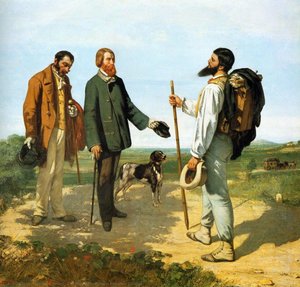
A Study in Quiet Observation: Gustave Courbet’s Reflection on Reality
Gustave Courbet, born Jean Désiré Gustave Courbet in Ornans, France, in 1819, stands as a pivotal figure in the history of art – a rebel who dared to confront the conventions of his era and champion an uncompromising vision of truth. More than just a painter; he was a sculptor, printmaker, and photographer, demonstrating a breadth of artistic exploration that cemented his legacy as one of France’s most influential artists.
- Early Influences & Formal Training: Courbet's formative years were marked by familial encouragement towards artistic pursuits – a rare circumstance for the time – fostering an ambition that propelled him toward the École des Beaux-Arts in Paris. However, he swiftly recognized the limitations of academic idealism and sought inspiration from artists like Eugène Delacroix and Théodore Géricault, acknowledging their stylistic prowess while simultaneously rejecting their romanticized narratives.
- The Birth of Realism: Courbet’s rejection of artistic dogma wasn't merely aesthetic; it was fundamentally philosophical. He argued passionately for portraying the world as he perceived it – unvarnished, honest, and devoid of embellishment—a stance that directly challenged the prevailing artistic trends of Romanticism. This conviction fueled his groundbreaking approach to painting, prioritizing meticulous observation over idealized representation.
- “A Brook in a Clearing” - A Testament to Detail: Consider Courbet’s “A Brook in a Clearing,” completed around 1865. This landscape masterpiece exemplifies Realist principles through its painstaking attention to detail and masterful use of atmospheric perspective. The painting captures the tranquil beauty of Fontcouverte with remarkable accuracy, reflecting Courbet's dedication to faithfully documenting the natural world as he experienced it.
Exploring Symbolism Within Everyday Scenes
Courbet’s artistic vision extended beyond mere visual representation; he imbued his works with subtle symbolic resonance. Unlike Romantic artists who sought to elevate subjects to lofty ideals, Courbet focused on capturing ordinary life – farmers, laborers, and rural landscapes—transforming these commonplace scenes into vehicles for social commentary. He aimed to depict the realities of the working class, confronting societal prejudices and advocating for a more egalitarian worldview.
- Social Critique: Courbet’s paintings frequently served as critiques of bourgeois society and its pretensions. By portraying subjects from marginalized communities with dignity and respect, he challenged artistic conventions that prioritized aristocratic grandeur over human experience.
- The Power of Observation: His technique—characterized by thick impasto brushstrokes and a deliberate rejection of blending—served not only to convey visual accuracy but also to imbue his canvases with emotional intensity. Courbet’s approach mirrored the broader Realist movement's belief in capturing the essence of human existence through direct observation.
“Study for Landscape with Waterfall” – Romantic Echoes Amidst Precision
"Study for Landscape with Waterfall," painted circa 1867, showcases Courbet’s ability to synthesize Romantic ideals with meticulous technique. While retaining the atmospheric grandeur characteristic of Romantic landscapes—particularly evident in the misty hues and dramatic lighting—the painting demonstrates Courbet's unwavering commitment to realism through detailed rendering of foliage and rock formations.
- Blending Styles: This artwork exemplifies Courbet’s masterful blending of stylistic influences, demonstrating that artistic innovation doesn’t necessitate abandoning established traditions but rather reimagining them within a framework of profound observation.
- Emotional Resonance: Despite its technical precision, “Study for Landscape with Waterfall” retains an undeniable emotional depth—a testament to Courbet's conviction that art should strive to convey genuine feeling alongside accurate depiction.
A Legacy Beyond Technique
Gustave Courbet’s enduring influence stems not solely from his artistic prowess but also from his courageous assertion of artistic independence. He irrevocably altered the course of art history, establishing Realism as a dominant aesthetic and inspiring generations of artists to confront societal injustices with unflinching honesty. His unwavering belief in portraying the world truthfully continues to resonate today, reminding us that true artistry lies in capturing the complexities of human experience—warts and all.



 Encargar reproducción
 Enviar
 Compartir
 Detalles

 Descargar
 Similares
 Radiografía
 Presentación de diapositivas


 Ver más






































 La opción de vidrio solo está disponible en tamaños inferiores a 110 cm.