Robert Tonge: A Scottish Visionary of the Early Victorian Era
Robert Tonge (1823-1856) emerges as a significant, yet often overlooked, figure in 19th-century British art. Born into a modest family in Scotland, his artistic journey unfolded against the backdrop of a rapidly changing nation – an era grappling with industrialization, romanticism, and burgeoning interest in the exotic. Tonge’s work, primarily landscapes and portraits, reflects this complex period, blending meticulous observation with a distinctly Romantic sensibility. His legacy lies not just in individual paintings but also in his contribution to the development of the Liverpool School of landscape painting, a movement characterized by its focus on capturing the subtle nuances of the Scottish countryside.
Tonge’s early life offered little indication of his future artistic pursuits. He was apprenticed as a clerk at the age of thirteen, a common practice for young men in Scotland at the time. However, a nascent talent for drawing and an innate appreciation for the natural world soon compelled him to pursue art seriously. He began formal training under John Brett, a prominent landscape painter associated with the Pre-Raphaelite Brotherhood, though Tonge never formally joined the group. Brett’s influence is evident in Tonge's careful attention to detail, his use of light and shadow, and his preference for depicting scenes of rural beauty. This early exposure shaped his artistic approach, grounding him in a tradition of Romantic landscape painting while also encouraging a keen observational skill.
The Liverpool School and Regional Identity
Tonge’s career truly flourished in the port city of Liverpool, a hub of trade and cultural exchange during the Victorian era. This location proved pivotal to his artistic development, placing him within the orbit of the “Liverpool School” of landscape painting. Unlike their London counterparts, artists associated with this school often focused on depicting scenes from their own region – the rugged beauty of Scotland, the rolling hills of Cheshire, and the dramatic coastline of North Wales. Tonge’s paintings frequently showcase these familiar landscapes, imbued with a sense of regional pride and identity.
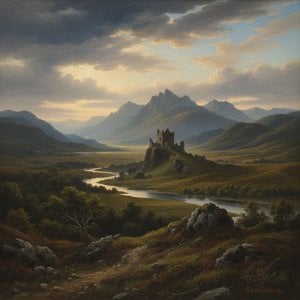
His subjects were not merely picturesque vistas; they were carefully constructed narratives. He often included elements that spoke to the lives of ordinary people – shepherds tending their flocks, farmers working in their fields, or travelers navigating the countryside. These details added layers of meaning to his paintings, transforming them from simple depictions of nature into reflections on rural life and the relationship between humanity and its environment. His work is particularly notable for capturing the atmospheric conditions of the Scottish Highlands—misty mornings, dramatic sunsets, and the ever-changing light that defines the region.
Technique and Style
Tonge’s artistic style can be characterized by a remarkable level of technical skill combined with an understated elegance. He was a master of capturing subtle tonal variations, creating a sense of depth and atmosphere in his paintings. His brushwork is generally smooth and controlled, yet he skillfully employed techniques to suggest texture and movement – the rustle of leaves, the flow of water, or the billowing of clouds. He frequently utilized a muted color palette, favoring earthy tones and subtle shades of blue and green, which contributed to the overall sense of realism and tranquility in his work.
A key element of Tonge’s style was his ability to render light with remarkable accuracy. He meticulously observed how light interacted with different surfaces – the wet grass, the rough stone walls, or the shimmering water – and translated these observations onto canvas. His paintings often feature a diffused, atmospheric quality, as if viewed through a veil of mist or haze. This technique not only enhanced the sense of realism but also evoked a feeling of mystery and enchantment.
Notable Works and Legacy
Among Tonge’s most celebrated works are “A Distant View of Frodsham, Cheshire,” a meticulously detailed depiction of a rural landscape; "Landscape with Stream," showcasing his ability to capture the beauty of flowing water; and “Brotherwater and Kirkstone Pass from Haws,” which exemplifies his mastery of atmospheric perspective. These paintings, along with many others in his oeuvre, demonstrate his exceptional talent and artistic vision.
Despite his untimely death at the age of 33, Robert Tonge left a lasting impact on British art. His work helped to establish the Liverpool School of landscape painting as a significant force within the broader context of Victorian art. His paintings continue to be admired for their technical skill, atmospheric quality, and evocative portrayal of the Scottish countryside. Today, his works are housed in museums across the United Kingdom, offering viewers a glimpse into the artistic world of a talented and often-forgotten painter.
Further research can be found at Art UK and on the website of the Robert Hull Fleming Museum in Burlington, Vermont.
Questions & Answers
Where are Robert Tonge's artworks grouped by technique?
Robert Tonge's works can be browsed by medium on the artist's All Medium page.
What aliases or alternate names does Robert Tonge have?
Robert Tonge appears under the alternate names Robert Andrews, Philip Tonge.
Where can I see Robert Tonge's artworks in chronological order?
The artist's Artwork Timeline page presents Robert Tonge's works ordered by date, year by year.