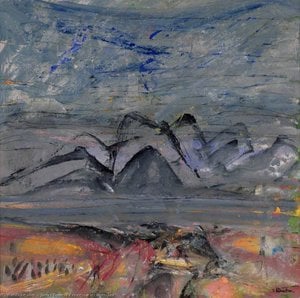
James Downie Robertson: A Painter of Ruin and Reverence
James Downie Robertson (1931-2010) wasn’t a name immediately recognized by the general public, yet within the realm of classical landscape painting and architectural documentation, he stands as a quietly significant figure. Born in Cowdenbeath, Scotland, his artistic journey began not with grand ambitions but with a deep fascination for the weathered beauty of ancient structures – particularly the evocative ruins of Greece. Robertson’s work isn't about romanticized vistas; it’s an intensely observational study of decay, light, and shadow, capturing the poignant dialogue between human ambition and the relentless passage of time. His canvases are imbued with a palpable sense of history, inviting viewers to contemplate not just what *was*, but what remains – and how that silence speaks volumes.Early Life and Artistic Training
Robertson’s formal training commenced at the Glasgow School of Art in 1950, where he was mentored by influential figures like David Donaldson and Joan Eardley. This environment fostered a keen eye for detail and an appreciation for both traditional techniques and a burgeoning modern sensibility. Following his studies, he spent time in Spain, absorbing the light and color of Southern Europe, before returning to Scotland and accepting a teaching post at Keith Grammar School. This period provided him with valuable experience in educating young artists, shaping not only his own practice but also contributing to the broader artistic landscape of the region. His later career saw him lecturing at various institutions across Britain and even internationally, cementing his reputation as a respected teacher and commentator on art history.The Language of Ruins: Technique and Subject Matter
Robertson’s distinctive style is immediately recognizable through its meticulous attention to detail and its masterful use of light and shadow. He primarily focused on classical landscapes – the crumbling temples of Greece, Roman ruins, and other vestiges of antiquity. His photographs, often taken in the late 19th and early 20th centuries, are characterized by a rich, almost sepia-toned palette, achieved through careful manipulation of his prints. This choice wasn’t merely aesthetic; it served to heighten the sense of age and decay, emphasizing the textures of stone and brick while simultaneously lending an air of solemnity to the scenes depicted. He employed a technique of layering and printing that allowed him to build up tonal values gradually, creating a remarkable depth and realism within his compositions. Crucially, Robertson wasn’t simply documenting these sites; he was attempting to capture their *essence*, conveying not just their physical form but also the stories they held – the echoes of empires past, the weight of centuries.- Key Subjects: Greek Temples (Olympian Zeus, Apollo at Corinth), Roman Ruins, and other ancient architectural sites.
- Technique: Meticulous observation, layered printing techniques to build tonal values, masterful use of light and shadow.
- Palette: Primarily sepia-toned, enhancing the sense of age and decay.
Major Works and Historical Significance
Robertson’s most celebrated works include a series of photographs documenting the temples of Greece, particularly the Temple of Olympian Zeus in Athens. These images are not merely reproductions; they're considered significant historical records, offering invaluable insights into the state of these structures during a period of rapid decline. His work stands as a testament to the beauty found within decay – a poignant reminder that even in ruin, there is enduring power and artistic merit. His meticulous documentation of ancient sites has been praised for its accuracy and detail, contributing significantly to our understanding of classical architecture. Furthermore, his approach—focusing on the *experience* of these ruins rather than simply their architectural form—influenced subsequent generations of landscape painters and photographers.Legacy and Continuing Influence
James Downie Robertson’s legacy extends beyond his individual artworks. He played a vital role in fostering an appreciation for classical art and architecture within Scotland, and his teaching career helped to nurture the talents of numerous young artists. His work continues to be exhibited and studied today, demonstrating its enduring appeal and relevance. The rediscovery of his photographs has highlighted the importance of preserving historical records and celebrating the beauty of decay – a perspective that resonates powerfully in our own time. The artist’s dedication to capturing the essence of ancient structures through meticulous observation and skillful technique ensures that his work will continue to inspire and captivate audiences for years to come.Questions & Answers
In which historical period did James Downie Robertson work?
James Downie Robertson worked in the Modern period. The period situates the artist's activity in history.
How is James Downie Robertson's career divided into periods?
A chronological account of James Downie Robertson's work is available on the artist's Chronicle page, where the artworks pass in order of creation, chapter by chapter.
Where are James Downie Robertson's artworks grouped by palette?
James Downie Robertson's works can be browsed by color palette on the artist's By Palettes page.