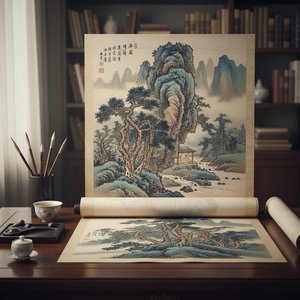
The Soul of Korean Landscape Painting
Heo Ryeon, known by the evocative pen-name Sochi, stands as a luminous figure in the annals of Korean art history. Born in 1809 during the twilight of the Joseon Dynasty, his life and work served as a profound testament to artistic integrity amidst an era of mounting national pressure and social transformation. To look upon a Heo Ryeon landscape is to witness more than mere scenery; it is to encounter the contemplative spirit of the Southern School, where every brushstroke seeks to capture the inner essence of the natural world rather than its outward superficiality.
His artistic journey was deeply rooted in the traditions of the yangban, the scholar-official class. Though born into a declining branch of this lineage, Ryeon chose to bypass the traditional path of bureaucratic service, dedicating his existence instead to the pursuit of namjonghwa, or Southern Style painting. This discipline, characterized by its emphasis on expressive brushwork and spiritual depth, allowed him to translate the philosophical ideals of Confucianism and Taoism onto silk and paper. His work often features the classic motifs of the literati—plum blossoms, bamboo, and orchids—each serving as a silent symbol of perseverance, humility, and an unyielding harmony with the cosmos.
Mastery of Ink and Light
The foundation of Ryeon’s technical brilliance was laid under the mentorship of Kim Jung-Hee, arguably Korea’s most celebrated literati painter. From this master, Heo Ryeon inherited a sophisticated understanding of Korean aesthetics, specifically the delicate balance between harmony and subtle emotional resonance. This training instilled in him the belief that art should function as a conduit for moral virtue and spiritual introspection. Under Kim's guidance, Ryeon learned to utilize monochrome ink washes to create atmosphere, favoring the quiet power of shadow and light over the distractions of vibrant color.
However, Ryeon was not merely a follower of tradition; he was an innovator who dared to expand the tonal vocabulary of his era. He is particularly renowned for his breathtaking rock paintings, which possess an unparalleled sense of geological weight and ethereal atmosphere. In a bold departure from prevailing conventions, he integrated Prussian blue pigment into his landscapes. This use of a new, imported pigment allowed him to achieve unprecedented depth and luminosity, creating mountainous vistas that seem to glow with an internal, otherworldly light. These works are masterclasses in texture, where the ruggedness of stone meets the softness of mist, reflecting a tension between the permanent and the transient.
A Legacy of Resilience
Beyond his technical achievements, Heo Ryeon’s significance lies in his role as a cultural anchor during a period of significant upheaval. As the Joseon Dynasty faced increasing internal pressures and external challenges, his dedication to the namjonghwa style represented a conscious rejection of formalized court traditions in favor of a more individualistic, soulful expression. His paintings became meditations on the human condition—celebrating the ability to remain steadfast and graceful amidst the storms of history.
His recognition during his lifetime was substantial; he earned the admiration of the Korean elite and even received commissions from King Heon-jong, a rare honor that solidified his status among the most revered painters of his generation. Today, the legacy of Heo Ryeon lives on through works that continue to resonate with modern audiences. His ability to distill the essence of nature into a language of ink and spirit ensures that he remains not just a historical figure, but a timeless voice in the global narrative of landscape art.
Questions & Answers
Is there a timeline of Heo Ryeon's works?
Heo Ryeon's artworks can be seen in chronological order on the artist's Artwork Timeline page.
Where are Heo Ryeon's artworks organized by color?
Heo Ryeon's works can be explored by color on the artist's Spectral Index page.
Where are Heo Ryeon's artworks mapped by subject?
The Subject Atlas page maps Heo Ryeon's artworks by subject.