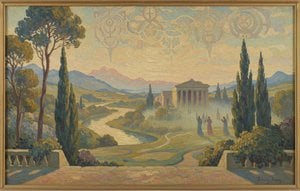
Ellen Thesleff: A Pioneer of Finnish Modernism
Early Life and Education
- Born in Helsinki, Finland in 1869, Ellen Thesleff was the eldest of five siblings. Her father, an amateur painter, fostered her early artistic inclinations.
- She received private lessons before formally studying at the Finnish Art Society Drawing School (now the Finnish Academy of Fine Arts) from 1887 to 1889 under Gunnar Berndtson.
- In 1891, Thesleff moved to Paris and enrolled at the Académie Colarossi, a pivotal step in her artistic journey.
Artistic Development and Influences
- Thesleff’s early work was heavily influenced by Symbolism, particularly the style of Eugène Carrière. However, she maintained that Édouard Manet had the most significant impact on her artistic vision.
- Her time in Paris exposed her to new ideas and techniques, shaping her evolving style. She also spent considerable time studying Renaissance art during visits to Italy beginning in 1894.
- Over time, Thesleff transitioned from Symbolism towards Expressionism and Modernism, increasingly focusing on landscapes as a primary subject matter.
Key Themes and Style
- Thesleff’s paintings are characterized by their evocative atmosphere, often depicting the Finnish landscape with a sense of solitude and introspection.
- Her portraits, such as “Ingeborg von Alfthan,” showcase muted tones and a focus on capturing the inner life of her subjects.
- She employed a restrained palette and expressive brushwork to convey emotion and mood in her work.
Major Achievements and Exhibitions
- Thesleff exhibited extensively throughout the 20th century, gaining recognition for her unique artistic voice.
- A significant milestone was a major exhibition of Nordic art in Copenhagen in 1949, where her paintings received critical acclaim from media outlets.
- She maintained a family estate at Murole, Ruovesi, Finland, which served as a source of inspiration for many of her landscapes. She never married and dedicated her life to her art.
Historical Significance and Legacy
- Ellen Thesleff is regarded as one of the leading Finnish modernist painters, playing a crucial role in the development of modern art in Finland.
- Her work bridges the gap between Symbolism and Expressionism, demonstrating a unique artistic sensibility that continues to resonate with audiences today.
- She paved the way for future generations of Finnish artists, inspiring them to explore new forms of expression and challenge traditional conventions.
Questions & Answers
Where is Ellen Thesleff from?
Ellen Thesleff was born in Finland.
How popular are Ellen Thesleff's artworks?
A Stats page exists for Ellen Thesleff, presenting statistics about the artist's artworks on this website.
Where can I see all artworks by Ellen Thesleff?
Every work by Ellen Thesleff on this website can be browsed from the artist's All Artworks page.