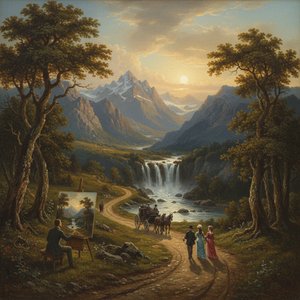
Eduardo León Garrido: A Master of Mexican Landscape and Portraiture
Born in Madrid in 1856, Eduardo León Garrido’s artistic journey was shaped by a complex interplay of familial legacy and personal ambition. The son of Fernando Garrido Tortosa, a politically active figure and amateur painter, León inherited both an appreciation for art and a desire to forge his own path within it. His early training at the Escuela Superior de Bellas Artes in Madrid laid a foundational understanding of academic techniques, but it was his time studying under Vicente Palmaroli that truly ignited his artistic vision – a vision deeply rooted in the burgeoning landscape traditions of Spain while simultaneously embracing the stylistic nuances of Impressionism.
León’s initial foray into the Parisian art scene proved pivotal. He arrived in 1875, seeking to refine his skills and gain exposure within a vibrant artistic community. This period wasn't without its challenges; initially denied a scholarship due to bureaucratic hurdles, he persevered through sheer determination, eventually securing funding that allowed him to continue his studies. It was during this time that he began to establish himself as a portraitist and landscape painter, quickly attracting the attention of prominent dealers like Adolphe Goupil, a connection that would prove invaluable throughout his career.
The Influence of Impressionism and the Belle Époque
León’s artistic style evolved significantly during his time in Paris. While firmly rooted in academic principles, he absorbed many elements from the Impressionist movement – particularly the emphasis on capturing fleeting moments of light and color, a departure from the more rigid conventions of earlier training. This influence is readily apparent in his depictions of Parisian street scenes, café terraces, and bustling marketplaces—images that offer a glimpse into the vibrant life of the Belle Époque. His paintings weren’t merely representations; they were imbued with a sense of immediacy and observation, reflecting the dynamism of modern urban existence.
However, León never fully abandoned his classical training. He remained deeply committed to portraying figures within meticulously rendered interiors, often evoking the atmosphere of 18th-century aristocratic salons. This juxtaposition of influences – Impressionistic brushwork combined with a nostalgic reverence for the past – is what defines his unique artistic signature. He skillfully blended these elements, creating works that are both contemporary and timeless.
A Return to Spain and the Pursuit of Patronage
Returning to Spain in 1888, León established a studio in La Varenne-Saint-Hilaire, near Paris, where he married Leonie Beck and began raising his family. He continued to exhibit his work at the Salon des Artistes Français and sought patronage from influential collectors and institutions. This period saw a shift towards painting more intimate scenes – portraits of his family, still lifes featuring flowers—works that offered a personal reflection on his life and surroundings.
Despite achieving recognition within Spain, León’s career was marked by a persistent struggle for financial stability. He relied heavily on commissions from wealthy patrons and the support of dealers like Félix Gérard, who provided him with a steady stream of work. His later years were characterized by a dedication to painting flower bouquets, a testament to his enduring love of nature and his meticulous attention to detail.
Legacy and Recognition
Eduardo León Garrido died in Caen, France, in 1949, leaving behind a substantial body of work that continues to be celebrated for its elegance, technical skill, and evocative atmosphere. His paintings are held in prestigious collections around the world, including the Museo del Prado in Madrid, the Museo Carmen Thyssen in Málaga, and private collections such as the Bellver Collection in Seville. His legacy extends beyond his individual works; he represents a crucial link between academic tradition and modern artistic sensibilities, embodying the spirit of a generation that sought to capture the beauty and complexity of the world around them.
Furthermore, León’s story is intertwined with that of other notable figures in the art world. His connection to Louis-Édouard Garrido, his father, and the influence of Vincent van Gogh through their shared employer, Adolphe Goupil & Cie, adds layers of intrigue to his artistic biography. His life serves as a reminder of the interconnectedness of artists and the enduring power of artistic legacy.
Questions & Answers
Can I browse Eduardo León Garrido's works by movement?
The All Movements page groups Eduardo León Garrido's artworks by art movement.
How do I find works by Eduardo León Garrido on a specific theme?
Eduardo León Garrido's works can be explored by keyword on the artist's By Keywords page. Each keyword groups the related artworks.
Is there a timeline of Eduardo León Garrido's works?
The artist's Artwork Timeline page presents Eduardo León Garrido's works ordered by date, year by year.