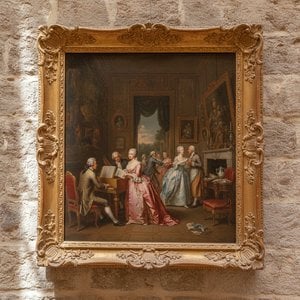
A Life Immersed in Historical Echoes: Adolphe Alexandre Lesrel
Adolphe Alexandre Lesrel, born in the coastal town of Gênes, France, in 1839, dedicated his life to capturing moments from history on canvas. While not a household name today, Lesrel was a highly respected and successful painter during his lifetime, specializing in historical genre scenes that resonated with the romanticized view of the past prevalent throughout the 19th century. His artistic journey began with formal training under the esteemed Jean-Léon Gérôme at the École des Beaux-Arts in Paris, an influence that would profoundly shape his meticulous technique and narrative style. Gérôme’s emphasis on detailed realism and dramatic composition became cornerstones of Lesrel's own approach to painting, setting him on a path toward depicting historical events with both accuracy and emotional depth.The Allure of the Past: Themes and Influences
Lesrel’s paintings are not grand depictions of pivotal battles or regal portraits; instead, he focused on intimate scenes within historical settings – moments of courtly life, musical practice, clandestine encounters, and religious ceremonies. This focus reflects a broader trend in 19th-century art fueled by the popularity of historical novels like those penned by Walter Scott and Alexander Dumas. These authors ignited public imagination with vivid portrayals of past eras, creating a demand for visual representations that brought these stories to life. Lesrel skillfully tapped into this desire, crafting scenes brimming with opulent detail and subtle narratives. He wasn’t merely illustrating history; he was recreating an atmosphere, inviting viewers to step back in time and witness the lives of those who came before. The influence of Jean-Louis-Ernest Meissonier is also readily apparent in Lesrel's work – a shared commitment to painstaking research and a highly finished style that prioritized historical accuracy in costume, furniture, and objets d’art.A Career Marked by Recognition
Lesrel steadily gained recognition throughout his career, exhibiting regularly at the Société des Artistes Français from 1885 onwards. His dedication was rewarded with an honorable mention at the Universal Exhibition in 1889, followed by his acceptance as an Associate of the Salon Nationale des Beaux-Arts in 1890. These accolades solidified his position within the French art establishment and ensured a consistent demand for his paintings among collectors both in France and abroad. His works found homes in prominent museums including those in Nantes, Rouen, Digne, and Saint-Lo, demonstrating their artistic merit and cultural significance. While he may not have achieved the widespread fame of some of his contemporaries, Lesrel’s sustained success speaks to his ability to connect with audiences through compelling storytelling and masterful technique.Technical Mastery and Artistic Legacy
Lesrel's paintings are characterized by a remarkable level of detail and a sophisticated use of light and shadow. He employed oil on canvas as his primary medium, building up layers of paint to create rich textures and evocative atmospheres. His compositions often feature carefully arranged figures within elaborate interiors, drawing the viewer’s eye to key moments of narrative tension or emotional intimacy. The artist's skill in rendering fabrics, jewelry, and architectural details is particularly noteworthy, contributing to the overall sense of realism and historical authenticity. In 2012, one of his paintings, The Practice Recital, fetched an impressive US$86,500 at a Sotheby’s auction, underscoring the enduring appeal of his work in the contemporary art market. While Lesrel's name may not be as widely recognized today, his paintings continue to captivate viewers with their beauty, detail, and ability to transport us to another time.Preserving Historical Moments
Adolphe Alexandre Lesrel passed away in 1929, leaving behind a legacy of meticulously crafted historical genre scenes that offer a glimpse into the past. His work serves as a testament to the power of art to preserve cultural memory and evoke emotional resonance. Though he specialized in recreating specific moments, his paintings also reflect broader themes of romance, intrigue, and social dynamics. Lesrel’s dedication to accuracy, combined with his artistic skill, ensures that his works will continue to be appreciated by art lovers for generations to come.- Born: Gênes, France (1839)
- Died: 1929
- Influenced by: Jean-Léon Gérôme and Jean-Louis-Ernest Meissonier
- Specialty: Historical Genre Painting
- Notable Museums: Musée des Beaux-Arts in Nantes, Musée des Beaux-Arts in Rouen.
Questions & Answers
What are the birth city and country of Adolphe Alexander Lesrel?
Adolphe Alexander Lesrel was born in Gênes, in France.
Is there a chronological account of Adolphe Alexander Lesrel?
The Chronicle of Adolphe Alexander Lesrel is a scroll-driven timeline that presents the artist's works in chronological order, grouped into career-period chapters.
Can I explore Adolphe Alexander Lesrel's works by color spectrum?
The Spectral Index of Adolphe Alexander Lesrel is a page that organizes the artist's artworks by their colors.
Is there a 3D virtual tour of Adolphe Alexander Lesrel's works?
Adolphe Alexander Lesrel's artworks can be seen in a 3D gallery on the artist's 3D Museum page.
Where is Adolphe Alexander Lesrel from?
Adolphe Alexander Lesrel was born in France.
In which movements did Adolphe Alexander Lesrel work?
The All Movements page groups Adolphe Alexander Lesrel's artworks by art movement.
In which historical period did Adolphe Alexander Lesrel work?
Adolphe Alexander Lesrel worked in the 19th-Century period. The period situates the artist's activity in history.
What are the birthplace and birth year of Adolphe Alexander Lesrel?
Adolphe Alexander Lesrel was born in Gênes in 1839.