FREE ART CONSULTATION

x
Buy Painting Buy PaintingBuy Image Buy Image SendSend
DetailsDetails Add to favorites Add to favorites DownloadDownload SimilarsSimilars X-RayX-Ray DiaporamaDiaporama

The Young Executive

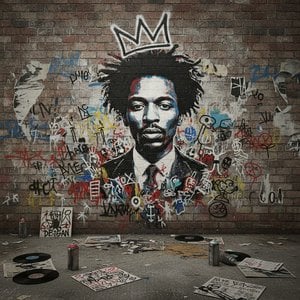
Intriguing charcoal portrait by George Condo, 'The Young Executive' captures a youthful subject with dramatic shading and expressive detail. A unique blend of realism and abstraction.

George Condo (b. 1957) is renowned for his 'Artificial Realism,' blending Old Master techniques with Pop Art & psychological depth. Explore his surreal portraits and cultural critiques.

Giclée / Art Print

Museum-quality giclée or canvas print with fast production and flexible finish options.

Standard
custom
CM
INCH

Pick from our preset sizes that match the artwork's original proportions.

width
height

You may enter your own dimensions to fit a specific frame or space. If your selected size does not match the original image's proportions, we will either crop the artwork or extend the image with a mirrored or solid-fill edge. A digital mockup will be sent for your approval before production begins.
Please note that the on-screen preview does not reflect the actual cropping or extension. Only the mockup will accurately show the final composition.
While custom sizes are available, we recommend selecting a dimension from the predefined list to preserve the original proportions.

Worldwide Delivery () in 2 weeks instead of standard 4/5 weeks. (7 July)

why_choose_icon
Free Worldwide Express Shipping
why_choose_icon
High-Quality Linen Canvas
why_choose_icon
Full Shipping Insurance
why_choose_icon
Customs Tax Refund Guarantee
why_choose_icon
True Color Matching Guarantee
why_choose_icon
60-Day Return Policy (Defects Only)
why_choose_icon
100% Money-Back Guarantee
why_choose_icon
Bulk Discount Offer

Total Price

-

reproduction

The Young Executive

Giclée / Art Print

Reproduction Size

-

Total Price

-

Quick Facts

  • Influences: Late 19th-century academic art
  • Subject or theme: Portrait of a young woman
  • Movement: Contemporary Art
  • Artist: George Condo
  • Medium: Charcoal on paper
  • Year: 2003

Art Quiz

There is only one correct answer for each question.

Question 1:
What artistic style best characterizes George Condo’s ‘The Young Executive’?
Question 2:
What is the primary medium used to create 'The Young Executive'?
Question 3:
What is a notable characteristic of the background in 'The Young Executive'?
Question 4:
What subtle symbolic element is included in the artwork?

Collectible Description

A Captivating Portrait: George Condo's "The Young Executive"

George Condo’s “The Young Executive” is a striking charcoal drawing that transcends simple portraiture. It presents a young woman rendered with an arresting blend of realism and expressive distortion, characteristic of Condo’s unique ‘Artificial Realism’ style. This piece isn't merely about capturing likeness; it delves into the psychological complexities of its subject, inviting viewers to contemplate her inner world.

Style & Technique: Artificial Realism in Charcoal

Condo is renowned for his 'Artificial Realism,' a fascinating fusion of Old Masters’ techniques and Pop Art sensibilities. In "The Young Executive," this manifests through the highly detailed rendering of the woman's features, reminiscent of classical portraiture, juxtaposed with an almost dreamlike quality created by the swirling charcoal background. The technique is primarily dry – relying on the pressure of the charcoal stick to build up volume and form. Notice how Condo utilizes hatching and cross-hatching to create a rich, layered texture that emphasizes the three-dimensionality of the subject’s face and hair. The dramatic shading creates a powerful sense of depth and mood.

Historical Context & Influences

Created in 2003, "The Young Executive" reflects Condo's ongoing exploration of portraiture within a contemporary context. While drawing inspiration from the academic portrait tradition of the late 19th century, Condo subverts it with his expressive and gestural approach. His artistic journey, shaped by early studies in art history and music theory, alongside connections to figures like Jean-Michel Basquiat, has fostered a unique visual language that blends high art references with elements of popular culture. The drawing’s aged appearance suggests a timeless quality, hinting at the enduring power of portraiture across generations.

Symbolism & Emotional Impact

While seemingly straightforward as a bust portrait, "The Young Executive" contains subtle symbolic nuances. The inclusion of carrots in the background is intriguing – perhaps suggesting a connection to nature or offering a playful contrast with the formality of the portrait style. More importantly, the drawing evokes a complex range of emotions. The woman’s gaze, combined with the dramatic lighting and expressive charcoal strokes, creates an atmosphere of quiet intensity and introspection. The swirling background adds to this sense of mystery, suggesting a world beyond the immediate subject. Ultimately, Condo's work invites viewers to project their own interpretations onto the portrait, fostering a deeply personal connection.

A Timeless Addition

“The Young Executive” is more than just a drawing; it’s an exploration of identity, emotion, and artistic expression. Its compelling composition, masterful technique, and subtle symbolism make it a captivating piece for art lovers, collectors, and interior designers alike. A hand-painted reproduction captures the nuances of Condo's charcoal work, bringing this powerful portrait into any space.


Artist Biography

A Synthesis of Past and Present: The World of George Condo

Born in Concord, New Hampshire, in 1957, George Condo emerged as a pivotal figure in contemporary art by forging an entirely unique visual language—one he himself termed “Artificial Realism.” This wasn’t merely a stylistic choice; it was a philosophical stance, a deliberate fusion of the revered techniques of Old Master painting with the vibrant, often chaotic energy of American pop culture. Condo's early life laid the groundwork for this synthesis. His academic pursuits at the University of Massachusetts Lowell encompassed both art history and music theory, fostering an appreciation for formal structure alongside a sensitivity to rhythm and composition. This musical inclination manifested in his involvement with the Boston punk scene as a bassist for The Girls, a band whose experimental sound foreshadowed the boundary-pushing spirit that would define his artistic career. The encounter with Jean-Michel Basquiat in 1979 proved transformative, prompting a relocation to New York City and a full immersion into the burgeoning art world. This move wasn’t simply geographical; it was a leap into a crucible of creativity where Condo could fully articulate his vision.

The Birth of Artificial Realism and East Village Roots

Condo's arrival in New York coincided with the explosive energy of the East Village art scene in the early 1980s. It was here, amidst a climate of experimentation and rebellion, that “Artificial Realism” took shape. He wasn’t interested in replicating reality; rather, he sought to create a *simulated* reality—one populated by psychologically complex figures rendered with the meticulous skill of historical masters but imbued with a distinctly modern sensibility. This approach involved a deliberate deconstruction of traditional portraiture, often presenting subjects with distorted features, fragmented forms, and an unsettling sense of alienation. A brief stint working at Andy Warhol’s Factory further honed his technical skills, contributing to the silkscreen production of Warhol's *Myths* series through the application of diamond dust—a subtle yet significant detail that speaks to Condo’s fascination with surface and illusion. His early exhibitions in East Village galleries established him as a force to be reckoned with, an artist who dared to challenge conventions and explore the darker undercurrents of contemporary life. Travels through Europe followed, connecting him with artists from the Mulheimer Freiheit group in Cologne, Germany, broadening his artistic horizons and solidifying his commitment to innovation.

Collaborations and Intellectual Currents

Condo’s career is marked not only by individual achievement but also by a series of compelling collaborations that enriched his practice and expanded its reach. Perhaps the most significant was his decade-long partnership with William S. Burroughs, beginning in 1988. Together they created paintings and sculptures that delved into themes of language, control, and the subconscious mind—a testament to their shared fascination with the power of imagery and narrative. This collaboration culminated in *Ghost of Chance*, a collection of writings and etchings published by the Whitney Museum in 1991, further cementing Condo’s intellectual credibility. His friendship with Keith Haring proved equally fruitful, providing access to studio space and inspiring works like *Dancing to Miles* (1985), which gained recognition at the 1987 Whitney Biennial. The influence wasn't solely artistic; philosophical currents also played a crucial role in shaping Condo’s thinking. The writings of Félix Guattari, particularly his analysis of Condo’s work, provided a theoretical framework for understanding the artist’s unique approach and its broader cultural implications.

Legacy and Enduring Influence

George Condo's impact on contemporary art is undeniable. He didn’t simply revive painting; he *reimagined* it, demonstrating that historical techniques could be harnessed to address modern anxieties and explore the complexities of the human psyche. His influence can be seen in the work of numerous artists, including Nigel Cooke, Sean Landers, John Currin, Lisa Yuskavage, and Glenn Brown—all of whom grapple with issues of representation, identity, and cultural critique. Beyond the visual arts, Condo’s work has resonated with writers such as Salman Rushdie, whose novel *Fury* drew inspiration from the haunting imagery of *The Psychoanalytic Puppeteer Losing His Mind* (1994), and David Means, who found inspiration in *The Fallen Butler* (2010) for his short story "The Butler's Lament." Even Allen Ginsberg recognized Condo’s unique talent, commissioning a portrait that graced the cover of his selected poems. Condo’s enduring legacy lies in his ability to bridge seemingly disparate worlds—the classical and the contemporary, the highbrow and the lowbrow—creating a body of work that is both intellectually stimulating and emotionally resonant. He remains a vital force in the art world, continually pushing boundaries and challenging our perceptions of reality.
George Condo

George Condo

1957 - , United States of America

Quick Facts

  • Artistic Movement Or Style: Artificial Realism
  • Artists Or Movements Influenced By This Artist:
    • Nigel Cooke
    • Sean Landers
    • John Currin
  • Artists Who Influenced This Artist:
    • Basquiat
    • Warhol
    • Cézanne
    • Picasso
  • Date Of Birth: 1957
  • Full Name: George Condo
  • Nationality: American
  • Notable Artworks:
    • Dreaming Woman
    • Colored Dream Objects
    • Billy Has Mind Tics
    • Dancing to Miles
    • The Psychoanalytic Puppeteer
  • Place Of Birth: Concord, USA
Explore artworks organized by themes, styles, and characteristics.