

Museum-quality giclée or canvas print with fast production and flexible finish options. ( Buy Hand Made Painting Switch to Digital Image)





























Pick from our preset sizes that match the artwork's original proportions.

Type the width and the height you need, to fit your frame or your wall. A print can only be cut, never made bigger than the picture, so a size with a different shape loses a part of the image. We send you a digital mockup to approve before we print anything. The picture shown on this page does not show the real cut — only the mockup does.
Worldwide Delivery () in 2 weeks instead of standard 4/5 weeks. (22 October)
untitled (4865)
Reproduction Size
In the quiet, turbulent corridors of early 20th-century art, few works possess the haunting, psychological depth found in Edvard Munch’s untitled (4865). Painted around 1902, this enigmatic masterpiece serves as a profound window into the soul, capturing much more than a mere likeness of its subjects. It is an evocative landscape of the human psyche, where the boundaries between reality and memory, or presence and absence, begin to dissolve. The painting presents us with a formally dressed man, anchored in the frame, yet he is shadowed by the spectral, semi-transparent presence of a female figure. This deliberate ambiguity creates a sense of profound vulnerability, inviting the viewer to step into a world where emotions are not merely felt but are visually manifested through color and form.
The composition is masterfully structured around a vertical axis that lends the piece both stability and a certain claustrophobic intensity. Munch utilizes a palette dominated by warm, earthy ochre and hazy yellow tones, which seem to vibrate with an inner light. This background does not merely serve as a setting; it acts as a living, breathing entity that merges with the ethereal woman, making her appear as much a projection of the man’s subconscious as a physical being. For the discerning collector or interior designer, this piece offers a sophisticated focal point—a work that commands attention through its subtle contrasts and its ability to anchor a room with its heavy, atmospheric presence.
To understand untitled (4865), one must look toward the heart of the Symbolist movement. Moving away from the objective observations of Impressionism, Munch embraced a style that prioritized subjective experience and emotional resonance. Influenced by the burgeoning field of psychoanalysis and the philosophical shifts of his era, he sought to paint "soul paintings"—works that captured the invisible tremors of fear, grief, and longing. The female figure in this work, appearing as a ghostly reflection, serves as a powerful symbol of the ephemeral nature of life and the persistence of memory, themes that were deeply personal to Munch following the tragic losses of his mother and sister.
The technical execution of the painting is nothing short of visceral. Employing oil on canvas, Munch utilized an impasto technique, where thick, deliberate brushstrokes create a palpable texture on the surface. These gestural lines and fluid forms reject anatomical precision in favor of movement and dynamism. The way the paint is layered allows light to catch the ridges of the strokes, adding a tactile dimension that enhances the painting's dreamlike quality. This expressive approach is a cornerstone of Expressionism, ensuring that every movement of the brush contributes to the overall mood of existential reflection.
For those looking to curate an environment of intellectual depth and emotional sophistication, this reproduction of Munch’s work offers unparalleled inspiration. The painting’s ability to evoke a sense of mystery makes it an ideal centerpiece for spaces dedicated to contemplation, such as private libraries, study halls, or avant-garde living areas. It does not merely decorate a wall; it initiates a dialogue with the viewer. The juxtaposition of the man's solid, formal presence against the fluid, translucent woman creates a tension that is both intellectually stimulating and aesthetically pleasing.
Investing in a high-quality reproduction of such a significant work allows for the preservation of its most vital element: its atmosphere. Whether placed in a contemporary setting to provide a striking historical contrast or integrated into a more classical interior to add layers of texture, untitled (4865) remains a timeless testament to the beauty found within human struggle. It is a piece that rewards repeated viewing, revealing new nuances of color and shadow each time the eye wanders across its expressive, textured surface.
The copyright answer for "untitled (4865)" by Edvard Munch: the work is in the public domain - its copyright has expired. This determines whether reproductions of the image may be freely made.
"untitled (4865)" by Edvard Munch conveys a reflective feeling within an overall dramatic mood.
Within Edvard Munch's career, "untitled (4865)" falls in the Early 20th Century. The phase helps compare it with the artist's other works.

Edvard Munch arrived in the world in 1863, born into the stark landscapes of Norway. His early years were defined by a heavy presence of grief that would later find its way onto his canvases. The deaths of his mother and his sister, Sophie, both taken by tuberculosis, left a deep mark on his young mind. These losses created a preoccupation with mortality and the fragility of life that stayed with him forever. He grew up in a household where the shadows of sickness were never far away.
His father, Christian, was a physician who struggled with intense religious devotion and mental instability. This atmosphere of dread and the vivid ghost stories told in his childhood helped shape his later visions. Munch did not merely paint what he saw; he sought to externalize his internal state. He called this approach soul painting. It was a way to translate psychological distress into visual form, using the colors and shapes of his own experience.
Munch began his formal studies at the Royal School of Art and Design in Kristiania, which is now known as Oslo. During this time, he moved within bohemian circles that challenged the strict rules of academic art. A significant influence was Hans Jæger, a nihilist who encouraged Munch to abandon conventional styles and instead focus on his own subjective emotions. This shift led him toward the development of Expressionism.
Travels through Europe brought new perspectives to his work. In Paris, he encountered the techniques of artists like Paul Gauguin and Vincent van Gogh, particularly their use of color. In Berlin, his connections with figures such as August Strindberg further pushed his investigations into psychological themes. He began to move away from naturalistic representation, opting instead for distorted forms and rhythmic lines that could communicate the tremors of human existence.
Much of his work belongs to a series he called The Frieze of Life, where he explored the recurring cycles of love, fear, death, and anxiety. Some of his most recognized paintings include:
Munch was a highly active printmaker, using techniques like etching, lithography, and woodcut to expand his reach. He possessed over one thousand paintings at the time of his death in 1944. His ability to confront the darker aspects of the human condition helped pave the way for later movements like German Expressionism. Today, much of his legacy is preserved in the Munch Museum in Oslo, where his work continues to speak to the complexities of the human psyche.

1863 - 1944 , Sweden

Journey through 10 iconic paintings bathed in 'sand' tones – from Van Gogh to Monet. Explore the stories, techniques & warm palettes of these timeless masterpieces. Find museum-quality art reproductions at and bring classic beauty home.

Explore 10 iconic paintings with captivating 'mushroom' tones! Discover Van Gogh, Monet & Rembrandt’s masterpieces—earthy palettes, rich history & artistic techniques. Find museum-quality art reproductions and curated decor ideas at

Explore the captivating world of earth tones! Discover their historical significance, psychological impact & artistic techniques. Find inspiration for your home decor and museum-quality reproductions at WahooArt.
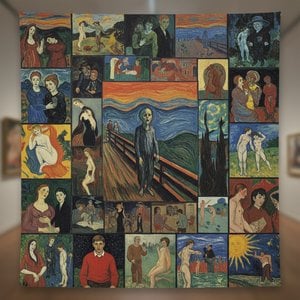
Explore 25 iconic Edvard Munch paintings, from 'The Scream' to lesser-known masterpieces. Discover the stories behind Expressionism’s most emotional works & find museum-quality art reproductions for your home at WahooArt.com.

Explore the captivating world of earth tones in art! Discover historical context, emotional resonance & artistic techniques behind these timeless colors. Find inspiration for your home decor and museum-quality reproductions.

 Preview
 Send
Send Share
Share
 Details
 Guide
Guide

 Download
 Similars
 X-Ray
X-Ray Diaporama
 Stats
Stats

 Read More









 Glass option is only available in size under 110 CM


