Artist Biography
A Life Defined by Geometric Harmony
Burgoyne Diller, a name perhaps less immediately recognizable than some of his contemporaries, occupies a pivotal position in the development of American abstract art. Born in The Bronx in 1906, Diller’s journey was one marked by both artistic conviction and personal hardship, ultimately leaving behind a legacy of rigorously geometric paintings that resonate with a quiet power. His early life was shadowed by loss; the death of his father when he was just three years old profoundly impacted him, leading to a relocation with his mother and stepfather to Battle Creek, Michigan. It was during a year-long illness in his youth, confined from school, that Diller first discovered his artistic inclination, filling sketchbooks as a means of expression and escape. This early period laid the foundation for a lifelong dedication to visual exploration. He pursued formal training at Michigan State University, graduating in 1927 before embarking on a peripatetic existence working odd jobs in Buffalo, New York – even taking on janitorial work – while simultaneously nurturing his artistic ambitions by selling his creations. This tenacity and self-reliance would become hallmarks of his career.
Embracing Abstraction: Influences and Development
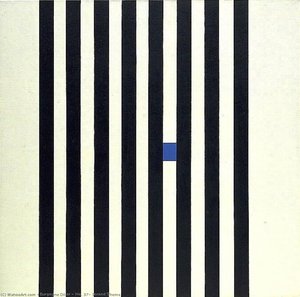
Diller’s arrival at the Art Students League in 1929 proved transformative. There, he encountered the teachings of Hans Hofmann, a German artist who emphasized the expressive potential of color and form, and began to forge his own distinct path. However, it was the burgeoning European movement of De Stijl, spearheaded by Piet Mondrian, that exerted the most profound influence on Diller’s aesthetic development. He became one of the earliest American proponents of Mondrian's geometric abstraction, embracing neoplasticism’s core principles: a reduction to essential forms – squares and rectangles – and a limited palette dominated by primary colors, black, and white. This wasn’t mere imitation; Diller internalized these ideas, developing three major compositional themes – “First,” “Second,” and “Third” – that served as frameworks for exploring the dynamic interplay between form and space. These weren't simply stylistic choices but rather investigations into the fundamental relationships governing visual perception. His commitment to non-objective art solidified his place among a growing circle of American artists pushing the boundaries of artistic expression, leading him to become a founding member of the American Abstract Artists group in 1937.
Beyond the Canvas: War, Teaching, and Personal Trials
Diller’s life took an unexpected turn with the outbreak of World War II. He enlisted in the U.S. Navy, not to paint patriotic murals, but to apply his inventive mind to practical problems. Assigned to the Training Aids Development Center, he conceived and patented a hand-held Morse code training device – a testament to his ingenuity beyond the realm of art. This invention was mass-produced for use by naval personnel, demonstrating Diller’s capacity for innovation and service. Following the war, he embarked on an academic career, becoming an assistant professor at Brooklyn College in 1946, eventually achieving tenure. However, this period was also marked by personal struggles. Financial difficulties plagued him, compounded by a devastating studio flood that destroyed much of his artwork. The loss of his wife, Sarah Conboy Diller, to alcoholism further deepened his hardships. Despite these challenges, he persevered in his artistic practice and continued to inspire generations of students.
A Lasting Legacy: Minimalism and Modernism
Burgoyne Diller’s contribution to American art lies not only in the striking visual impact of his geometric abstractions but also in their historical significance. He served as a crucial link between the early abstract movements of the 1930s and the rise of Minimalism in the 1950s and 60s. His austere, rigorously controlled compositions anticipated the reductive aesthetic embraced by artists like Donald Judd and Ellsworth Kelly. Diller’s dedication to harmony, stability, and order through precise forms established him as a pioneer of modernism, influencing countless artists who followed. Today, his works are held in prestigious museum collections including The Museum of Modern Art, The Metropolitan Museum of Art, and the Art Institute of Chicago – enduring testaments to his vision and skill. He remains a compelling figure whose work continues to invite contemplation on the power of abstraction and the pursuit of visual purity. His story is one of artistic dedication, resilience in the face of adversity, and a lasting impact on the landscape of American art.



 Buy Hand Made Painting


 Preview
 Send
Send Share
Share
 Details
 Guide
Guide

 Download
 Similars
 X-Ray
X-Ray Diaporama
 Q&A
Q&A
 Stats
Stats

 Read More






































 Glass option is only available in size under 110 CM