A Tapestry of Stone and Spirit: The Soul of St. Giovanni a Carbonara
In the beating heart of Naples, where the shadows of ancient Roman walls meet the vibrant pulse of modern Italian life, lies St. Giovanni a Carbonara—a sanctuary that transcends the boundaries of a mere church to become a living chronicle of human devotion and artistic triumph. To step across its threshold is to embark on a journey through time, moving seamlessly from the rugged strength of Romanesque foundations into the soaring, ethereal heights of Gothic architecture. The very air within these walls seems heavy with the weight of centuries, whispering tales of the Knights Hospitaller who once tended to pilgrims and the Augustinian monks who laid the groundwork for this monumental complex in 1343. It is a place where the terrestrial and the divine converge, offering a profound sensory experience that captivates the soul of every wanderer.
The architectural narrative of St. Giovanni a Carbonara is one of continuous, breathtaking evolution. While its bones are rooted in the Gotico Angioino style, the structure has been masterfully layered by successive generations of visionaries. The exterior presents a dramatic encounter with Ferdinando Sanfelice’s 18th-century scenographic stairwell, a theatrical entrance that prepares the visitor for the splendor within. As one moves deeper into the nave, the Latin Cross plan unfolds, leading the eye toward an interior that serves as a masterclass in Neapolitan Baroque and Renaissance grandeur. The interplay of light and shadow across polychrome marble altars and intricate stone carvings creates a dynamic atmosphere, making the building feel less like a static monument and more like a breathing organism of art.
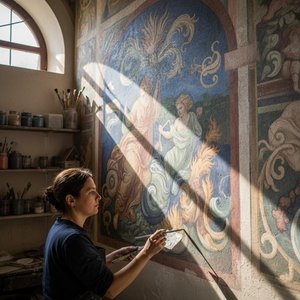
For the discerning lover of fine art, the true treasures lie within the hidden corners of the Cappella Caracciolo. This sacred space acts as a luminous jewel box, draped in vibrant frescoes that showcase the pinnacle of artistic virtuosity. Here, the brushwork of Pietro da Cortona and Giuseppe Buonamassa breathes life into biblical narratives, utilizing techniques that echo the dramatic chiaroscuro of Caravaggio. These walls are not merely decorated; they are alive with movement and emotion, designed to inspire awe and contemplation. Beyond the frescoes, the church houses the solemn and magnificent tombs of King Ladislan I of Naples and Ser Gianni Caracciolo, sculptural masterpieces that embody the Renaissance ideal of eternal remembrance through stone.
What truly distinguishes St. Giovanni a Carbonara from the many historic churches of Naples is its profound duality—the marriage of the visible splendor above with the silent mysteries below. Beneath the feet of every visitor lies an ongoing archaeological frontier, where excavations continue to reveal the fragmented glory of Roman Naples. This hidden dimension provides a hauntingly beautiful contrast to the Renaissance brilliance overhead, reminding us that every layer of art is built upon the dust of antiquity. For collectors of history and designers of atmosphere, this site offers an unparalleled inspiration, representing a perfect, unbroken lineage of human creativity, from the ancient foundations of a thriving port city to the triumphant heights of the Baroque era.