William Mark Fisher (1841–1923): Bridging Impressionism and Pastoral England
William Mark Fisher, born in Boston, Massachusetts, emerged as a pivotal figure in the burgeoning English Impressionist movement during the late Victorian era. Though relatively unknown today, his canvases captured the essence of rural life and idyllic landscapes with remarkable sensitivity and technical prowess—a style that resonated deeply with contemporaries and cemented his place among England’s most celebrated landscape painters.
Fisher's artistic journey began amidst the intellectual ferment of Boston’s art scene, where he absorbed influences from luminaries like George Inness and Jules Bastien-Lepage. These artists championed plein air painting – working outdoors directly from nature – a technique that prioritized capturing fleeting moments of light and atmosphere. This commitment to observation would become a cornerstone of Fisher's distinctive artistic vision.
His formal training included studies at the Boston School of Fine Arts, honing his skills in draughtsmanship and color theory. However, it was his relocation to England in 1871 that truly propelled him into artistic prominence. Establishing himself in Worcestershire, he embraced the picturesque Worcestershire countryside as his primary subject matter, producing a prolific body of work characterized by soft brushstrokes, muted palettes, and an unwavering focus on capturing the beauty of rural landscapes.
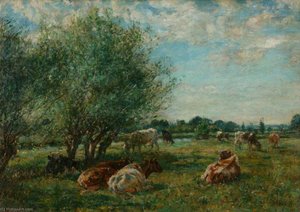
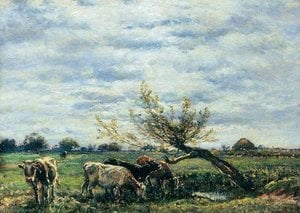
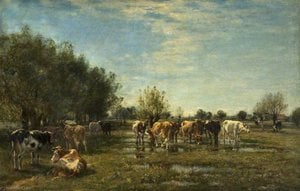
Fisher’s paintings frequently depict pastoral scenes featuring cows grazing peacefully amidst rolling hills—images that evoke a profound sense of tranquility and nostalgia for a bygone era. He skillfully employed atmospheric perspective – layering colors to convey depth and distance – creating canvases that shimmer with subtle gradations of light and shadow. His meticulous attention to detail, combined with his masterful handling of color, distinguishes him from many of his peers and elevates his work to the level of artistic excellence.
Fisher’s paintings gained considerable acclaim during his lifetime, particularly through exhibitions at the Royal Academy in London. These showings showcased his ability to translate Impressionist principles into compelling visual narratives—telling stories about the natural world without resorting to dramatic gestures or overtly expressive brushwork. His landscapes were lauded for their beauty and accuracy, establishing him as a leading voice within the English Impressionist movement.
Fisher’s legacy extends beyond his individual paintings; he helped foster a broader appreciation for plein air painting and contributed significantly to the development of British landscape art. Although largely forgotten by mainstream art history for decades, recent scholarship has begun to reassess Fisher's importance, recognizing him as a crucial link between Impressionism and the subsequent artistic trends of the early 20th century. Today, his paintings reside in museums across Europe and North America—testaments to their enduring beauty and artistic merit.