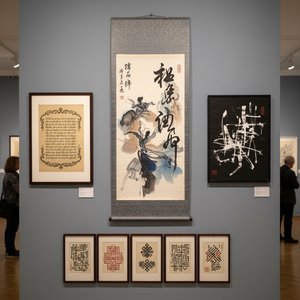
Said Dokins: A Calligrapher of Social Witness
Born in Mexico City in 1983, Said Dokins is a contemporary artist whose work transcends the boundaries of traditional art forms, forging a powerful dialogue between calligraphy, graffiti, and social commentary. His practice isn’t merely about creating images; it's an active engagement with urban space, history, and the complex narratives woven within them. Dokins’ journey began in the vibrant streets of Mexico City as a young graffiti writer, a formative experience that instilled in him a deep understanding of movement, texture, and the immediate impact of visual interventions.
His formal training at the School of Arts and Design (ENAP) within the National Autonomous University of Mexico (UNAM) provided a crucial foundation. This academic grounding was further enriched by studies in Western calligraphy with renowned masters like Denis Brown and Carl Rohrs, alongside explorations of Japanese calligraphy under the guidance of Master Masahiko Hiyama. These diverse influences converged to shape his unique style – a potent synthesis of ancient traditions, contemporary techniques, and a profound awareness of cultural heritage.
The Language of Intervention
Dokins’ work is fundamentally rooted in the belief that writing possesses inherent political power. He views calligraphy not as an ornamental craft but as a means of interpreting existence, a tool for interrogating social structures and exposing power dynamics within urban environments. This conviction manifests most strikingly in his large-scale public interventions – monumental murals, site-specific installations, and expansive calligraphic gestures that disrupt the flow of everyday life.
Central to Dokins’ approach is the deliberate juxtaposition of seemingly disparate elements: the philosophical text alongside the performative action, the phrase transformed into a tangible event. He meticulously considers the specific context of each intervention, drawing upon local histories, community narratives, and the symbolic weight of the chosen location. His work often incorporates quotes from thinkers – figures who challenge conventional modes of understanding – creating a dynamic interplay between past and present.
A Fusion of Traditions
Dokins’ distinctive style is characterized by a remarkable fusion of diverse influences. He seamlessly blends Western calligraphy traditions with references to pre-Hispanic Mesoamerican symbolism, drawing upon the rich visual language of ancient cultures. Simultaneously, he incorporates elements of graffiti writing – the rebellious energy and immediacy of street art – creating a hybrid aesthetic that is both deeply rooted in tradition and strikingly contemporary.
This unique synthesis is most evident in his “Primitive Alphabet,” a series of letters brought to life through various mediums, from traditional paper and canvas to immersive installations, light paintings, and expansive mural interventions. The alphabet’s evolution across these different formats underscores Dokins' exploration of the relationship between memory, signs, and their modes of representation. His work is not simply decorative; it’s a deliberate act of re-contextualization, breathing new life into ancient symbols and imbuing them with contemporary relevance.
Recognition and Legacy
Said Dokins' work has garnered significant recognition both nationally and internationally. He was named one of the “Most Creative Mexicans” by Forbes Magazine in 2017, a testament to his innovative approach and profound impact on the Mexican art scene. His murals have been exhibited in prestigious venues across Europe, North America, and South America, including museums and galleries in Spain, Germany, Holland, Belgium, United Kingdom, France, China, Argentina, Chile, and Brazil. His work is also part of the collections of the Polytechnic University of Valencia (Spain) and the Museum of Contemporary Art of Bogotá (MACBO), Colombia.
Dokins’ participation in major street art festivals – Nuart Festival in Norway, IPAF Festival in South Africa, and Brisbane Street Art Festival in Australia – has further cemented his position as a leading figure in contemporary public art. His retrospective exhibition at the Centro de las Artes de San Luis Potosí in 2019, “Escrituras en Fuga” (“Runaway Writings”), showcased a decade of work, solidifying his legacy as a vital voice in the dialogue between art, social commentary, and urban space.
Further Exploration
For more information about Said Dokins’ work and exhibitions, please visit: Said Dokins - Contemporary Artist and Calligrapher
Ερωτήσεις και Απαντήσεις
Από πού προέρχεται ο/η Said Dokins;
Ο/Η Said Dokins γεννήθηκε στην/στη Mexico.
Πώς μπορώ να παρακολουθήσω το έργο του/της Said Dokins χρονολογικά;
Τα έργα του καλλιτέχνη Said Dokins μπορούν να περιηγηθούν χρονολογικά στη σελίδα Χρονολόγιο Έργων.
Υπάρχει μια επισκόπηση όλων των θεμάτων που έχει ζωγραφίσει ο/η Said Dokins;
Εξερευνήστε τα έργα του/της Said Dokins ανά θέμα στη σελίδα Ατλάς Θεμάτων του καλλιτέχνη/της.