Nilima Sheikh: A Voice of Tradition and Displacement
Nilima Sheikh, born November 18, 1945, in New Delhi, India, is a visual artist whose work explores profound themes of displacement, longing for heritage, and the complexities of identity within the context of historical narratives. Her artistic journey began with formal training in Western oil painting but swiftly transitioned to a deeply personal engagement with miniature manuscript painting traditions—a deliberate choice rooted in her fascination with pre-modern Rajput and Mughal court paintings and their distinctive tempera techniques. This formative influence continues to permeate her oeuvre, informing her stylistic approach and conceptual framework.
Sheikh’s artistic development was significantly shaped by encounters with influential figures like Ghulam Mohammed Sheikh (whose work explored similar themes of cultural identity), Nancy Spero, May Stevens, and Ana Mendieta—artists who championed feminist perspectives on artmaking and challenged conventional representations of femininity. These connections fostered a critical awareness of social and political contexts, propelling her to investigate issues of communal violence and nationalism alongside explorations of personal experience and memory.
Her early education at Delhi University instilled in her a rigorous intellectual curiosity that translated into meticulous research regarding traditional Indian art forms—a cornerstone of her artistic practice. Sheikh actively advocated for the sustainability of these traditions, recognizing their importance as repositories of cultural knowledge and aesthetic values. She meticulously documented and analyzed diverse visual sources, ranging from folktales to historical texts, integrating them seamlessly into her paintings, scrolls, and installations.
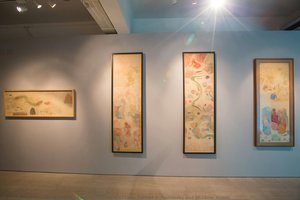
Sheikh’s artistic output has garnered considerable acclaim internationally. Her debut museum exhibition at The Art Institute of Chicago in 2014 showcased a selection of her paintings that captivated audiences with their evocative imagery and nuanced storytelling. Furthermore, she participated in Documenta 14 (Athens & Kassel) in 2017, cementing her position as a prominent voice within contemporary art discourse. Her work has been recognized for its ability to grapple with challenging subjects—particularly the experiences of marginalized communities—while simultaneously honoring artistic heritage.
Sheikh’s distinctive visual language blends elements of manuscript painting traditions with experimental techniques—such as scroll painting and stencil printing—to convey narratives that resonate across cultures and historical periods. Recurring motifs include landscapes imbued with symbolic significance, portraits reflecting inner states of emotion, and intricate patterns reminiscent of Mughal decorative arts. Her artistic vision consistently seeks to articulate the tensions between personal introspection and broader social commentary, demonstrating a commitment to confronting difficult truths while maintaining an unwavering appreciation for beauty and craftsmanship.
- Notable Exhibitions: Documenta 14 (Athens & Kassel), Art Institute of Chicago
- Influential Artists: Ghulam Mohammed Sheikh, Nancy Spero, May Stevens, Ana Mendieta
- Painting Techniques: Tempera Painting, Miniature Manuscript Painting
- Themes Explored: Displacement, Femininity, Communal Violence, Historical Lineage
Source: Wikipedia & Aware Women Artists