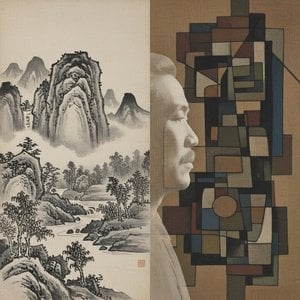
Matsuo Bashō: Life and Legacy
Early Life and Background
- Born Matsuo Kinsaku in 1644 near Ueno, Iga Province, Japan.
- Came from a family with samurai roots, though his father was likely a low-ranking retainer.
- Received an early education and showed an aptitude for poetry.
- Served as a page to Tōdō Yoshitada, fostering his interest in *haikai no renga* (linked verse).
Artistic Development and Influences
- Initially focused on collaborative poetry forms like *renga*.
- The death of his patron, Tōdō Yoshitada, in 1666 marked a turning point, leading him to dedicate himself fully to poetry.
- Influenced by Zen Buddhism, which emphasized simplicity, mindfulness, and connection with nature.
- Early works showed conventional styles but gradually evolved towards a more minimalist and evocative approach.
- Chinese poetry also played a role in shaping his aesthetic sensibilities.
The Rise of Haiku and Bashō’s Style
- Bashō is credited with elevating the *hokku* (the opening verse of a *renga*) to an independent poetic form, later known as haiku.
- His haiku are characterized by their concise language, vivid imagery, and focus on nature.
- He sought to capture fleeting moments and evoke deep emotions with minimal words.
- Emphasized *sabi* – the beauty of transience, imperfection, and age – in his work.
Travels and Major Works
- Bashō embarked on several journeys throughout Japan, seeking inspiration for his poetry.
- His most famous travelogue is Oku no Hosomichi (The Narrow Road to the Deep North), published in 1694.
- Other notable works include *Nozarashi kikō* (Records of a Weather-Exposed Skeleton) and numerous collections of haiku and *renga*.
- His travel writings blended poetry with prose, creating a unique literary style known as haibun.
Achievements and Historical Significance
- Widely regarded as the greatest master of haiku in Japanese history.
- Revolutionized the art of *haikai no renga* by emphasizing naturalness and emotional depth.
- His work influenced generations of poets and continues to be studied and admired today.
- Bashō’s poetry is often reproduced on monuments and traditional sites throughout Japan, demonstrating his enduring cultural impact.
- He helped establish haiku as a major art form, recognized for its ability to capture the essence of life in a few carefully chosen words.
Legacy
- Bashō’s emphasis on direct experience and observation continues to resonate with artists and writers worldwide.
- His minimalist style has influenced modern poetry and other art forms.
- He remains a symbol of Japanese artistic excellence and spiritual depth.
Ερωτήσεις και Απαντήσεις
Πού ομαδοποιούνται τα έργα του ΜัตΣουο Μπάσο με βάση λέξεις-κλειδιά;
Για να βρείτε έργα του ΜัตΣουο Μπάσο με συγκεκριμένο θέμα, επισκεφθείτε τη σελίδα Με Λέξεις-Κλειδιά του καλλιτέχνη, η οποία ομαδοποιεί τα έργα ανά λέξη-κλειδί.
Ποια χρώματα χρησιμοποίησε πιο συχνά ο/η ΜัตΣουο Μπάσο;
Το χρωματικό προφίλ των έργων του/της ΜัตΣουο Μπάσο εμφανίζεται στη σελίδα Γενετικό Σύστατο Παλέτας του καλλιτέχνη/της.
Πού και πότε γεννήθηκε ο/η ΜัตΣουο Μπάσο;
Ο/Η ΜัตΣουο Μπάσο γεννήθηκε στην/στη Ueno το 1644.