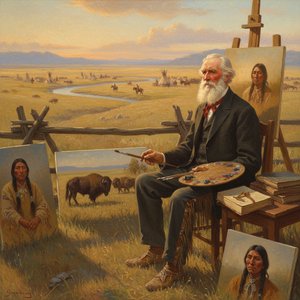
Louis Siegriest (1899–1989): California Painter of Myth and Landscape
Louis Bassi Siegriest (Oakland, CA. 1899 – November 7, 1989) was a major California artist who lived and painted in Virginia City, Nevada, during the 1940s. He established a studio there after moving from New York City where he had begun his artistic journey as an Impressionist, evolving into an Abstract Expressionist. Siegriest’s distinctive style blended meticulous observation of the natural world with symbolic representations rooted in Native American mythology and folklore—a combination that cemented his place among the Society of Six, a group of influential California artists who championed modernist aesthetics.
Early Life and Artistic Training
Born in Oakland, California, Siegriest received his initial artistic education from Frank Van Sloun at Mark Hopkins School, where he honed his skills alongside fellow artists like Selden Connor Gile, Maurice Logan, Bernard von Eichman, and William H. Clapp. He continued his studies with Robert Henri at the Art Students League in New York City, immersing himself in the burgeoning avant-garde movement of the time. This formative period instilled in him a commitment to capturing the essence of human experience through bold brushstrokes and expressive color palettes—a stylistic approach that would characterize much of his subsequent work.
The Society of Six and Virginia City Influence
Siegriest’s association with The Society of Six profoundly shaped his artistic vision. This collective championed a distinctly Californian aesthetic, prioritizing landscapes imbued with spiritual resonance and exploring themes of myth and ritual. Moving to Virginia City in 1946, Siegriest found inspiration in the rugged beauty of Nevada's High Desert—a setting that fueled his prolific output during the Depression era. His paintings from this period depict scenes of Native American life, particularly depictions of hunting rituals and shamanistic practices, reflecting a deep fascination with indigenous cultures and their connection to the natural world.
Notable Works and Artistic Style
Siegriest’s oeuvre encompasses a diverse range of subjects—from monumental landscapes capturing the grandeur of Yosemite National Park to intimate portraits exploring psychological depth. However, he is perhaps best remembered for his evocative depictions of Native American ceremonies and myths, notably “Antelope Hunt from a Navaho Drawing,” which exemplifies his meticulous attention to detail and symbolic representation. His canvases are characterized by layered textures—often incorporating sand and other natural materials—creating surfaces that convey both visual richness and tactile immediacy. Furthermore, Siegriest’s use of color—particularly muted hues reminiscent of twilight—contributes to the atmospheric quality of his paintings, fostering a contemplative mood that invites viewers to contemplate profound themes of spirituality and human connection.
Legacy and Recognition
Louis Siegriest's artistic legacy extends beyond his individual creations; he served as an influential mentor to younger artists and championed the importance of exploring cultural traditions within the context of modern art. His work was exhibited extensively throughout his lifetime, securing its place in prominent museums including Saint Louis Art Museum and The Smithsonian American Art Museum. Nancy Boas lauded Siegriest as “the grand old man of California art,” recognizing his enduring contribution to the artistic landscape of the 20th century—a testament to his unwavering dedication to capturing the spirit of both the natural world and human experience through a uniquely expressive visual language.