Filippo Lippi: A Renaissance Rebel and Master of Light
Filippo Lippi, born around 1406 in Florence and tragically dying in Spoleto in 1469, remains one of the most enigmatic and compelling figures of the Early Renaissance. More than just a painter, he was a complex individual – a reluctant friar, a passionate lover, a rebellious spirit, and ultimately, a profoundly gifted artist who defied convention and redefined the possibilities of visual storytelling. His life, shrouded in both romantic legend and documented scandal, mirrors the turbulent artistic landscape of his time, while his art continues to captivate with its luminous beauty and psychological depth.
Early Life and Unconventional Beginnings
Lippi’s early years were marked by an unusual upbringing. Orphaned at two, he was entrusted to the care of his aunt, who placed him in the Carmelite friary of Santa Maria del Carmine in Florence – a decision driven more by necessity than affection. This placement, however, proved transformative. While initially intended as a temporary arrangement, Lippi’s artistic talent quickly shone through, captivating the attention of the prior and leading to his formal entry into the order at the age of sixteen. His life within the friary was far from serene; he struggled with religious discipline, harboring a deep-seated desire for worldly pleasures – most notably, a passionate affair with Lucrezia Buti, a nun who bore him two children. This scandalous relationship led to his expulsion from the convent and eventual marriage, forever branding him as a figure of contradiction: a devout artist wrestling with earthly desires. This unconventional background profoundly shaped his artistic vision, imbuing it with a sense of human drama and emotional complexity rarely seen in contemporary works.
Influences and Artistic Development
Lippi’s early style was undeniably influenced by the revolutionary work of Masaccio at the Brancacci Chapel in Santa Maria del Carmine. The use of linear perspective, anatomical accuracy, and a nascent sense of realism were all hallmarks of Masaccio's approach, and Lippi initially adopted these techniques with enthusiasm. However, as he matured, his style underwent a dramatic shift, moving away from strict academic precision towards a more expressive and decorative aesthetic. He embraced rich color palettes, intricate details – particularly in drapery and ornamentation – and a dynamic sense of movement that set him apart from his contemporaries. His work began to reflect the humanist ideals of the era, exploring psychological states and capturing fleeting moments of emotion with unprecedented sensitivity. The influence of Donatello’s sculpture is also evident in Lippi's figures, particularly their dynamism and expressive gestures.
Major Works and Innovations
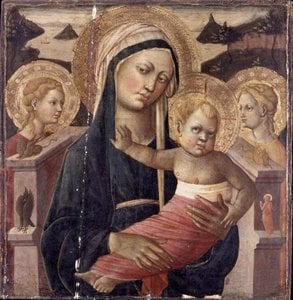
Lippi’s artistic output was remarkably prolific, encompassing a diverse range of subjects including religious scenes, portraits, and decorative panels. His *Madonna and Child Enthroned* (c. 1437-1438), now in the Uffizi Gallery, exemplifies his early style – characterized by meticulous detail, balanced composition, and a subtle use of perspective. However, it was his monumental fresco cycle in Prato Cathedral, depicting the lives of St Stephen and St John the Baptist (1452–66), that cemented his reputation as one of the greatest artists of his time. This ambitious project showcased Lippi’s mastery of color, composition, and narrative storytelling, establishing him as a leading figure in the Florentine art world. Furthermore, he pioneered the use of the *sacra conversazione*, a format featuring multiple figures within a single frame, creating dynamic and engaging compositions that were revolutionary for their time. His work on the Barbadori Altarpiece (1437-1440) is considered one of the earliest examples of this innovative approach.
Legacy and Historical Significance
Filippo Lippi’s legacy extends far beyond his individual works. He was a pivotal figure in the transition from Gothic to Renaissance art, embodying the spirit of innovation and experimentation that characterized the era. His willingness to challenge conventional artistic norms – both religious and stylistic – made him a controversial yet admired figure. His influence on subsequent generations of artists is undeniable, particularly Sandro Botticelli, who undoubtedly studied under Lippi and absorbed his distinctive style. Lippi’s life story—a blend of piety, passion, scandal, and artistic genius—continues to fascinate art historians and enthusiasts alike, solidifying his place as one of the most intriguing and important figures in Renaissance Italy. His work remains a testament to the power of art to capture both the beauty and the complexities of human experience.