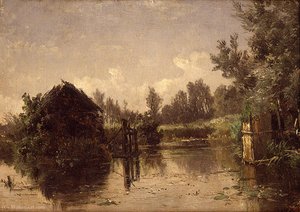
A Pioneer of Spanish Realist Landscape Painting
Carlos de Haes, born in Brussels on January 25, 1829, and tragically passing away in Madrid on June 17, 1898, stands as a monumental figure in the history of Spanish art. More than just a painter, he was a revolutionary—a bridge between the established traditions of Northern European landscape painting and the burgeoning realist movement that would define much of 19th-century Spain. His journey began far from the sun-drenched hillsides he would later immortalize; initially raised within a family of bankers, his upbringing instilled in him a meticulous attention to detail and an appreciation for observation—qualities that would profoundly shape his artistic approach. A pivotal moment arrived in 1835 when his family relocated to Málaga, immersing him in the vibrant culture and distinctive light of Andalusia, a region that would become the enduring subject of his life’s work. Early training under Luis de la Cruz y Ríos, a prominent neoclassical portraitist, provided a solid foundation in artistic technique, but it was his subsequent studies with Joseph Quinaux, a Flemish landscape painter renowned for his *en plein air* methods, that truly ignited his creative spirit. Quinaux's insistence on painting directly from nature—a radical departure from the prevailing practice of studio-bound work—became inextricably linked to de Haes’s name and fundamentally altered the course of Spanish art education. These formative years were further enriched by extensive travels throughout Europe – Holland, France, and Germany – exposing him to a diverse range of artistic styles and broadening his understanding of landscape representation in its myriad forms.
Forging a New Path in Spain
Upon returning to Spain in 1855, de Haes swiftly established himself within the national art scene, actively participating in the prestigious National Exhibitions of Fine Arts. His work steadily gained recognition for its increasing sophistication and technical mastery. However, his true legacy began to take shape with his appointment as professor of landscape painting at the Real Academia de Bellas Artes de San Fernando in 1857. This wasn’t merely a professional advancement; it was a seismic shift—a deliberate challenge to the established academic traditions that had long dominated Spanish art education. De Haes championed *en plein air* painting and direct observation from nature, advocating for a method that prioritized capturing the immediate reality of the landscape rather than relying on idealized representations or studio-based techniques. He became an Academician at the Royal Academy in 1860, solidifying his position as a leading voice within the artistic community. His teaching extended far beyond imparting technical skills; he fostered a generation of landscape painters who embraced outdoor work and sought to capture the essence of Spain’s diverse topography – from the rugged peaks of the Picos de Europa to the sun-drenched plains of Andalusia. Among his most notable students were Jaime Morera, Aureliano de Beruete, and Darío de Regoyos—artists who would themselves become leading figures in Spanish Realism, carrying forward de Haes’s revolutionary approach.
Style, Influences, and Artistic Evolution
De Haes is fundamentally recognized as a Realist painter, prioritizing accurate representation over romanticized ideals. His early works demonstrate this commitment, meticulously capturing the details of light, atmosphere, and terrain with remarkable precision. However, his style wasn't static; it evolved organically over time, reflecting his deepening understanding of both Spanish landscapes and broader European artistic influences. While retaining a strong connection to the principles instilled by Quinaux – particularly the importance of direct observation – he gradually incorporated elements from the Barbizon School, characterized by looser brushwork and an increased emphasis on conveying atmospheric effects. This shift is evident in a growing sensitivity to mood and nuance within his landscapes—a subtle yet profound transformation that elevated his work beyond mere documentation to something akin to emotional resonance. The influence of Joseph Quinaux remained paramount throughout his career, continually reinforcing the value of observing nature directly and translating those observations onto canvas. Beyond this foundational mentorship, de Haes drew inspiration from a wide range of European landscape traditions encountered during his travels, synthesizing these influences into a uniquely Spanish vision—a style that was both rooted in tradition and profoundly contemporary. He wasn’t simply replicating what he saw; he was interpreting it through a lens shaped by his Belgian origins and his deep immersion in the Spanish environment. This synthesis allowed him to capture “something of a particularly Spanish ‘essence’” as contemporaries noted – a quality that distinguished his work from purely imitative representations.
Major Achievements and Recognition
Carlos de Haes’s impact on Spanish art is undeniable, marked by both professional accolades and enduring artistic legacy. His active participation in the National Exhibitions of Fine Arts provided a platform for showcasing his evolving style and garnering critical acclaim. However, it was his appointment as professor at the Real Academia de Bellas Artes de San Fernando that truly cemented his place in history—transforming him from a respected artist into a pivotal figure in shaping the future of Spanish landscape painting. His advocacy for *en plein air* painting revolutionized artistic practice and elevated the status of landscape within the broader art world. The acquisition of “La Canal de Mancorbo en los Picos de Europa” by the Museo del Prado, a testament to its realism and significance, stands as a powerful symbol of his influence. De Haes’s dedication to depicting Spain’s natural beauty with accuracy and sensitivity continues to inspire artists today. His prolific output – approximately 4,000 paintings and sketches – ensures that his work will be studied and appreciated for generations to come.
Exploring De Haes’s Work Today
Fortunately, experiencing the artistry of Carlos de Haes is more accessible than ever. WahooArt.com offers meticulously hand-painted reproductions of his iconic works, allowing art enthusiasts to bring the beauty and realism of Spanish landscapes into their own homes. From detailed copies of Los Picos de Europa, capturing the grandeur of the mountains, to serene depictions like Left Channel, showcasing his mastery of light and atmosphere, these reproductions offer a tangible connection to a pivotal figure in art history. Exploring his oeuvre through platforms like WahooArt provides not only aesthetic pleasure but also an opportunity to appreciate the enduring legacy of a painter who dared to challenge convention and capture the essence of Spain with unparalleled skill and sensitivity.